As an Amazon Associate I earn from qualifying purchases. Links below are affiliate links, which means I may earn a commission at no extra cost to you.
Curb appeal is usually a conversation about porches, and a renter does not have one. What an apartment has is a rectangle of glass above a sidewalk, and that rectangle does all the work: it is the only part of your home a stranger sees. Apartment window christmas lights are therefore a design problem with a fixed viewpoint. You are not decorating a room. You are composing for someone walking past at six in the evening, thirty feet away, in a coat, not stopping.
Quick answer
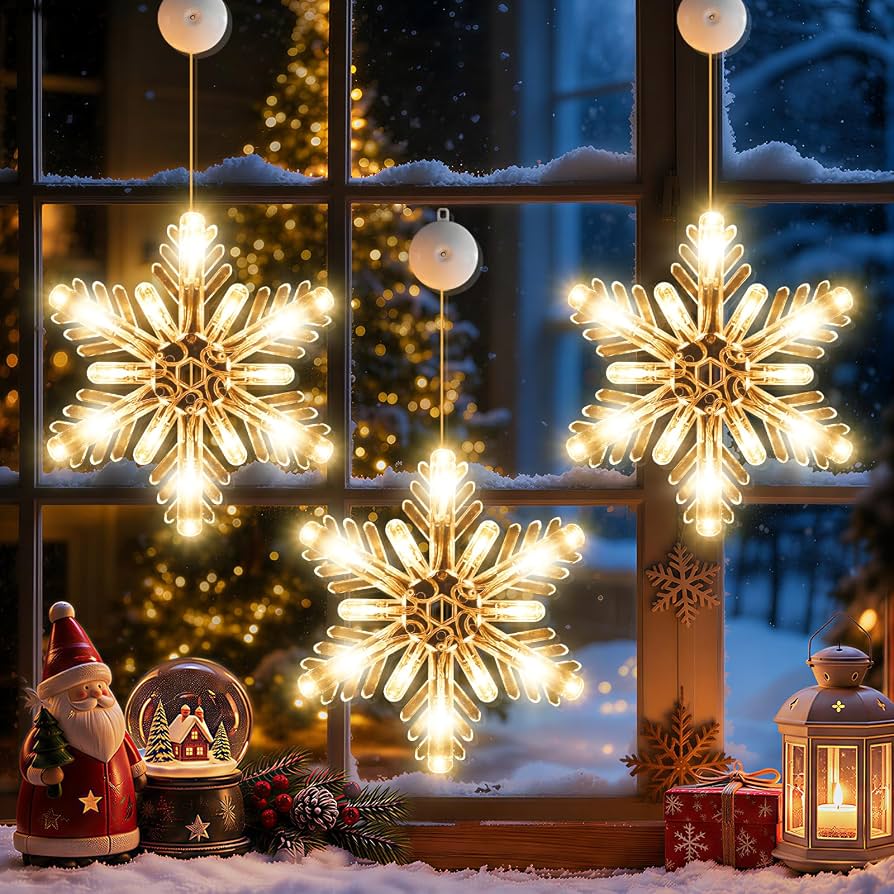
Design for distance, not detail. Three larger shapes in a horizontal row beat six small ones, one warm source beats three colors, and upper floors need more brightness rather than more ornaments. See the three-piece set on Amazon for the version that suits most apartment windows.
Apartment Window Christmas Lights: Design for the Sidewalk
Stand where the viewer stands before you hang anything. That is the most useful five minutes in the process.
Three things change with distance. Detail goes first: a decoration that is charming at arm’s length becomes a smudge at forty feet. Contrast matters more than color, which is why a warm shape on dark glass reads and a pale one on a lit room does not. And vertical spacing compresses: three pieces stacked up a window look fine from inside and crowded from the street.
Horizontal rows keep their spacing from any angle on the sidewalk. Vertical stacks do not.
Which floors gain the most
| Floor | Angle and distance | What works |
|---|---|---|
| Ground | Near eye level, 10–30 ft | A full arrangement; detail survives |
| Second | About 30° up, 15–30 ft | One horizontal row, three pieces |
| Third to fifth | Steeper, 30–60 ft | Larger shapes, maximum contrast |
| Sixth and up | 60 ft or more | A glow, not a composition |
The second and third floors are the sweet spot. Far enough that the window reads as one picture, close enough that a single warm shape still resolves.
Above the fifth floor the physics change. Nobody on the sidewalk is looking up at that angle, and the people who do see the window are across the street at the same height. Different audience: put the pieces at the height of that viewer and treat the window as a lit rectangle viewed from a gap.
If this is your first set, the complete guide to choosing Christmas window lights covers mounting and power in more depth.
Brightness balance
The eye adapts to whatever is brightest in the frame, and everything else falls away.
A window that is too bright becomes a white rectangle with no shape inside it. A window that is too dim disappears next to a neighbor’s porch light. The target is a window that is clearly the brightest thing in its own frame, and roughly as bright as the brightest window on the block — not brighter.
Practically, that means one source. Three snowflakes with thirty-six LEDs across the set produce one even pool of warm light. Add a second string in the same window and you double the brightness without adding a readable shape.
One detail costs nothing: turn off the lamp nearest the window. Interior light bouncing off the inside of the glass is what flattens a silhouette from outside.
Silhouettes beat clutter
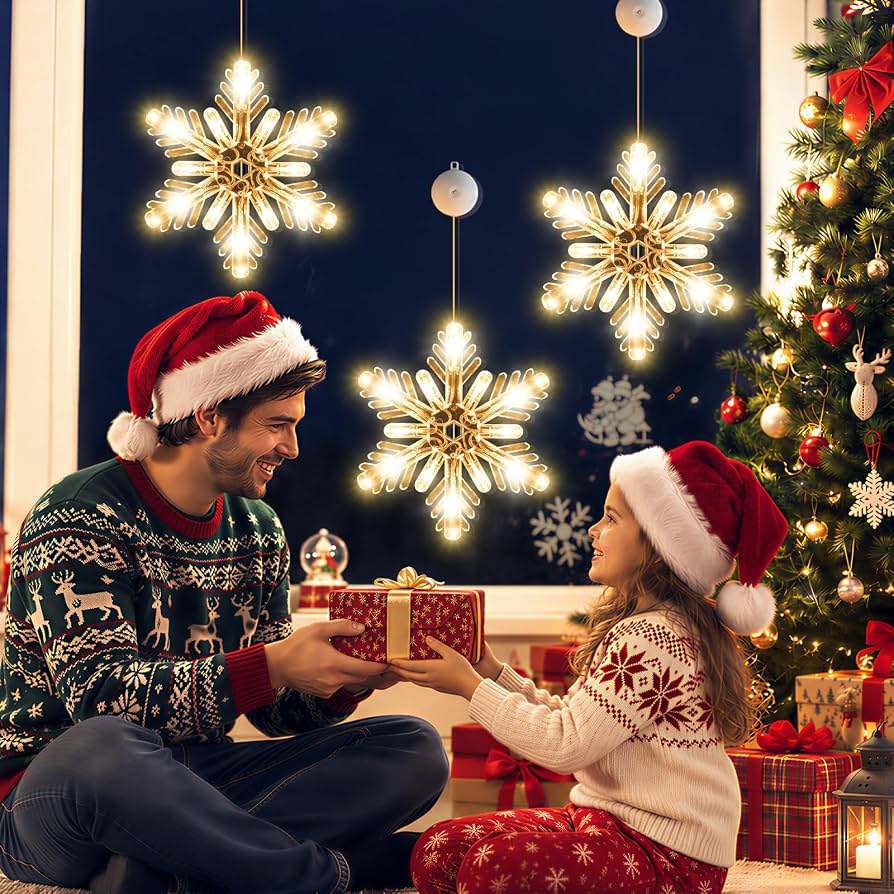
The image that travels best down a street is a dark shape with a glowing edge, because the shape is the only thing to look at.
Clutter kills it. Three small decorations, a garland, a string along the sash, and a wreath on the same pane add up to a lit rectangle, not a picture. Fewer, larger, better spaced wins at distance.
Curtains are the other half. A closed sheer curtain diffuses the light into a soft panel, which is fine and often prettier than raw bulbs. A heavy curtain hides everything. Blinds cut hard horizontal stripes across the shapes. The compromise: leave the lower half of the blind up so the display has an unobstructed band. The zero-hole window plan for apartments covers mounting on the glass itself, which sidesteps the curtain entirely.
The hour that matters
Between five and nine in the evening on a weeknight is when people walk past. In December that hour is entirely dark, so the display never competes with daylight.
The six-hours-on, eighteen-off timer runs from the moment you switch the unit on, so the switch-on hour is a design decision. Set it for half past four and the window is lit from dusk until half past ten. Set it at noon and the bulbs burn through the afternoon and go dark at six, exactly when the sidewalk fills.
Three AAA cells per piece is the cost of that schedule. Buy spares with the first set.
What to check before you buy
- Indoor rating. These are indoor window lights. Exterior mounting is a different product and usually a lease violation.
- Batteries are extra. Three AAA per piece, nine for the set, not in the box.
- Clean, smooth glass. A dirty or textured pane will not hold a suction cup.
- Fixed warm white. One color. This is not a color-changing set.
- Decorative output. Thirty-six LEDs across three pieces glow; they do not light a room.
The honest limit: from the sixth floor, or a window facing a courtyard wall ten feet away, none of this reads as curb appeal. The set does not get brighter with altitude, and there is no viewer to design for. Skip the curb-appeal plan and decorate for yourself.
The renter-friendly decorations you can move are worth a look if you expect to change apartments before next December, and the first apartment starter kit covers what to buy around the window.
FAQ
Do window lights actually improve curb appeal?
For a rental building, they are most of what you can control. A lit window at eye level on a dark facade is the one thing a passerby registers.
How bright should the window be compared to neighbors?
Roughly equal to the brightest window on the block, not brighter. You want the eye to land on your window because of the shape, not because it glares.
Does a screen or storm window ruin the effect?
A screen softens the edges slightly. A storm window adds a second reflection, which is why turning off the interior lamp matters more in older buildings. Neither stops a warm shape reading from the curb.
Bottom line
Walk to the sidewalk, look up, and design for that view: three shapes in a row, one warm source, the lamp by the glass switched off. Small work for the only decoration a stranger will ever see. View the warm-white set on Amazon if the window is your storefront, and hang it before the first cold snap.
Views: 0