As an Amazon Associate I earn from qualifying purchases. Links below are affiliate links, which means I may earn a commission at no extra cost to you.
The winter wonderland look in a store window is built from bags of fake snow, a fog machine, and a team that sweeps up after closing. At home that translates into a mess you are still vacuuming in February, plus cotton batting that yellows by the second season. Winter wonderland window decorations can skip all of it. The look does not come from powder. It comes from white surfaces, one warm light source, and three layers of depth behind the glass.

Quick answer
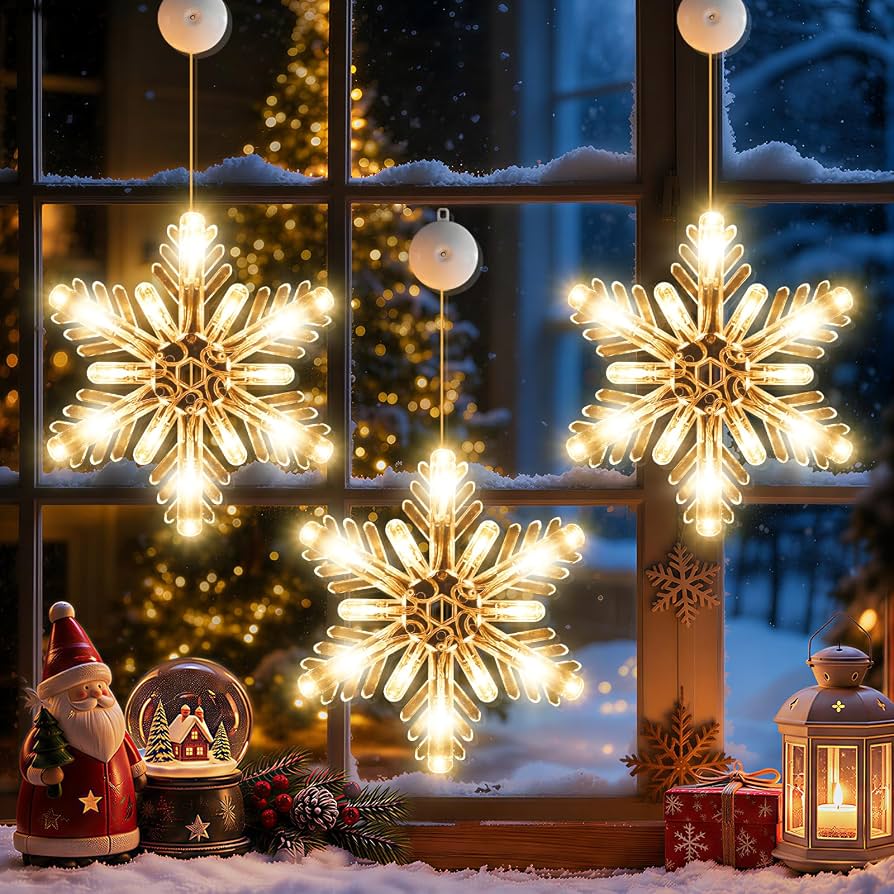
Build frost from reflection instead of material: a white board behind the glass, a few snowflake shapes on the glass, and warm white light between them. That is the entire effect, and it takes one purchase rather than a cart of props. A three-piece battery-powered snowflake set covers the lit layer, with a timer so nothing needs switching. Check the current price on Amazon.
Winter Wonderland Window Decorations Without Loose Fake Snow
Fake snow fails at home for three reasons. It migrates, because static lifts the flakes onto the sill, the floor and eventually the whole room. It yellows, because cotton batting and polyester fluff pick up dust and ultraviolet light, and by January the snowdrift is beige. And it hides the light: a pile of fluff in front of a lit shape absorbs the glow you paid for.
The replacement is white paper and reflection: a sheet of white card on the sill does the same job as a snowdrift from 20 feet away, and it stores flat.
Frost is a reflection problem
Snow reads white because it bounces light in every direction. You can fake that with any flat white surface placed where the light from your decorations can reach it.
Three options, in order of effort:
| Material | Where it goes | Why it works |
|---|---|---|
| White foam board | Standing on the sill, behind the glass | Bounces the snowflake glow back into the room |
| A plain mirror or mirror tile | Leaning against the frame | Doubles the shape and adds a bright edge |
| White paper or a paper bag, cut flat | Taped to the back of the sill | Lowest effort; invisible at 20 feet |
The trick is placement, not material. Push the white surface within about two inches of the glass, where the flakes’ light hits it. At six inches the bounce falls off.
A strip of white paper along the bottom of the pane reads as a snowbank from the street. Keep it below the sill line so it looks like accumulation rather than a shelf.
Three layers in four inches of depth
The winter look is a depth effect. Flat decorations on one plane read as stickers no matter how good they are. Build back to front:
- Back layer, on the sill. The white board or mirror, sitting close to the glass.
- Middle layer, on the glass. Two or three lit snowflakes, spaced with equal gaps, tops aligned.
- Front layer, the room. Nothing. This is the part people get wrong, because a lit lamp behind the viewer flattens everything.
Four inches between the back board and the glass is plenty; more starts to look like a diorama. The guide to layered window displays goes into how many layers a small pane can hold before it turns into clutter.
Put the budget into one thing
The useful rule is to spend on the element that works in the dark and skip the elements that only work in daylight.
Props are daylight objects. Miniature houses, tiny fences and figurines are visible for the two hours before dusk and invisible for the four hours after, which is when anyone actually looks at a window in December. They also break first.
Light is a night object and the only thing that survives a dark evening. One set with a timer outperforms a shelf of props, because the window is lit when you are not home to switch it on. Six hours on, eighteen off, starting when you choose, is why the display looks maintained rather than remembered.
Keep the palette to white and warm
Blue lights are the fastest way to break the effect. A blue strand makes the white surfaces around it look yellow, and the snow turns to dishwater.
Stay in two colors: white surfaces, warm white light. That combination is what reads as snow at night, because a warm source keeps the white board looking like a lit surface rather than a gray one. If this window is one part of a larger scheme, the room-by-room guide to cohesive Christmas decorating explains how far to carry the same palette before it gets tired.
One caveat: the white board will look like a white board in daylight. Tape it low, behind the sill line, and accept that this display peaks between five and nine in the evening. If your walls are already warm, the window color schemes that work with your walls will tell you whether to push the white brighter.
What to check before you buy
- Indoor use only. These are interior decorations, not exterior ones.
- Three AAA batteries per piece, not included.
- Clean, smooth glass for the suction cups to seat on.
- Warm white only, not color-changing.
- 36 LEDs total, so plan on ambience rather than room light.
The honest limitation: this look depends on white surfaces catching the light. On dark wood sills with no board behind the glass, warm snowflakes read amber and the winter effect never arrives. If you want a full snowy village with houses and trees, skip this method; that scene needs shelf depth and a box of props to store.
FAQ
Do I need fake snow at all?
No. A white board and a mirror do the same job with no mess, and they store flat. If you already own batting, keep it behind the glass rather than in front of the lights.
Will a mirror make the window look bigger or busier?
Bigger, if it sits behind the shapes and reflects them. Busier, if it faces the room and reflects your furniture. Angle it toward the glass.
How much light does the window need?
One set of three pieces is enough for a normal pane. The effect comes from contrast with a dark room, so more light usually makes it worse, not better.
Bottom line
Winter wonderland windows are built from three things: a white surface to bounce light, snowflake shapes on the glass, and a warm source with a timer. Nothing in that list spills, yellows or needs sweeping. See the three-piece snowflake set on Amazon for the lit layer, and start with the ten arrangements for ordinary windows if you have not picked a layout yet.
Views: 0