As an Amazon Associate I earn from qualifying purchases. Links below are affiliate links, which means I may earn a commission at no extra cost to you.
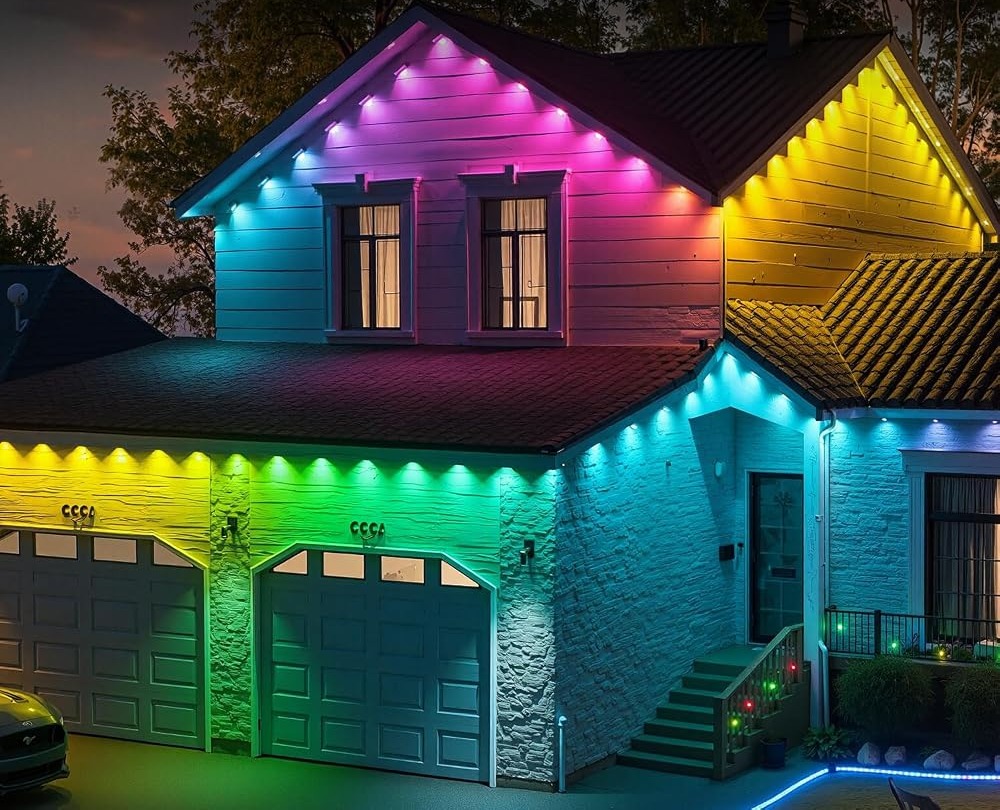
LED eave lights live in a different category from string lights draped for a party. They are mounted once, usually high on the fascia or under the soffit, and expected to look right in every season. That raises the stakes on a few decisions that are easy to overlook at purchase: how long the run is, how far apart the pixels sit, which surface you are attaching to, and how the weather rating is worded. This guide covers those criteria in plain terms and explains who should choose a permanent set over seasonal decor. A 100ft, 50-pixel RGB+IC run is the working example.

Quick answer
LED eave lights should be chosen by run length, pixel spacing, mounting surface, weather rating and power type, not by mode count alone. Measure the roofline first, then match it to a 100ft RGB+IC set with 50 individually controlled LEDs. Add an outlet for the 24V adapter and a sheltered spot for the control box. Check the current price on Amazon.
How to choose LED eave lights for your roofline
Begin at the roofline, because that is what the display will outline. Walk the front edge with a tape measure and note the returns at each corner. A run that looks generous on paper can feel short once soft bends and a detour around a chimney are accounted for. Sketching the route also shows where the adapter and control box can sit without crossing a doorway.
From there, think about viewing distance. A roof edge seen from the street reads as a continuous line, so spacing of about two feet between pixels is acceptable. A soffit mount directly above a patio is viewed from below, where the same spacing is more visible. Neither is wrong; they simply favor slightly different choices. For the full set of buying decisions, the permanent outdoor lights buying guide lays out the framework.
Run length and pixel spacing
Two numbers do most of the work: total length and LED count. A 100ft run with 50 Smart RGB+IC LEDs puts roughly one pixel every two feet. That is enough for a clean outline along a front elevation and leaves room for short side returns.
| Criterion | Why it matters |
|---|---|
| Run length | Must cover the front edge and corners |
| LED count | Sets how smooth effects look |
| Pixel spacing | Two feet reads well from the street |
| Bend radius | Soft corners protect the strip |
| Control lead | Needs an outlet at the start |
A longer run is generally more flexible than a shorter one, provided you have somewhere to route the extra length. To see how feet translate into real coverage, compare it with a simple framework for house exterior lighting.
Fascia vs soffit mounting
The mounting surface shapes the install. Fascia is the vertical board behind the gutter and offers a flat face that suits the self-adhesive backing, provided it is clean and dry. Soffit is the underside of the roof overhang; mounting there changes the viewing angle and suits a wash effect on a covered area.
The set offers both self-adhesive backing and screw-in fixing, so you are not locked into one method. Adhesive is tidy on smooth surfaces and avoids drilling. Screws are wiser on textured or painted surfaces where a bond is less certain, and they make future removal cleaner. Using both gives the most secure hold. Whichever you choose, prepare the surface first — dust and moisture defeat adhesive faster than cold weather does.
Weather rating and low-voltage power
Read the weather wording as it is written. The seller rates the strip IP67 waterproof and says the control box and adapter are rainproof. That is a seller-stated rating, not a claim that any part tolerates immersion. In practice, shelter the control box and adapter from direct water and keep the adapter near an outlet. The anti-UV material and the stated -4°F to 140°F operating range support year-round use in a normal climate.
The system is 24V low voltage, which suits a long exterior run and underpins the seller’s safety note around children and elderly household members. It is a wired setup, so plan the power route before you stick anything down. Life is rated up to 50,000 hours according to the listing — an estimate rather than a promise.
What to check before you buy
LED eave lights are a fixture, not a seasonal purchase. Check these before you commit.
- Measure the front edge and add both corner returns.
- Confirm an outlet for the 24V adapter.
- Plan a sheltered spot for the rainproof control box.
- Check whether fascia or soffit suits your viewing angle.
- Treat IP67 as the seller’s rating, not a submersion claim.
- Read 50,000 hours as a listing estimate.
FAQ
Are LED eave lights worth it over seasonal lights?
They are worth it if you want the outline up all year and change the look in an app instead of climbing a ladder each season. If you move often or prefer a different shape every year, the fixed nature works against you. If the idea of one display for every season appeals, why permanent christmas lights work year-round makes the case.
Do I need to drill into the fascia?
Not necessarily. The set includes self-adhesive backing and screw-in fixing. Adhesive suits a smooth, clean fascia; screws are better on textured surfaces or where you want a removable hold. Many installs use both for security, especially on an exposed corner.
Can I use the set near a pool or sprinkler?
Keep the adapter and control box sheltered from direct water, and do not treat the IP67 rating as permission to submerge any part. Normal rain is what the rating addresses. Plan the placement so water does not pool around the control box, and route the cable clear of sprinkler heads.
LED eave lights reward careful measuring and honest planning about the mounting surface. Get those right and the rest is straightforward. For the wider set of choices, the broader outdoor lighting buying guide puts eave lights in context. If you are ready, see the 100ft RGB+IC eave lights on Amazon to check the current set.
Views: 0