As an Amazon Associate I earn from qualifying purchases. Links below are affiliate links, which means I may earn a commission at no extra cost to you.
Battery vs hardwired outdoor lights is a decision about where your lights live and how much you want to think about them. Battery decorations are portable and easy to place, but they need fresh cells or recharging and tend to be modest in scale. Hardwired lighting draws from a household outlet and stays put, which suits a long run you want to leave up. A 100ft RGB+IC eave set sits firmly in the wired camp, using a low-voltage 24V system. This comparison explains where that choice helps and where a battery option might still make more sense.
Quick answer
Battery vs hardwired outdoor lights comes down to freedom of placement versus steady power. Battery lights go anywhere but need charging and suit small, temporary displays. Hardwired lights need an outlet nearby but run continuously without battery upkeep, which suits a permanent roofline. For a long eave run you leave up year round, the wired 24V approach is the practical category. Check the current price on Amazon.
Battery vs Hardwired Outdoor Lights: Head to Head
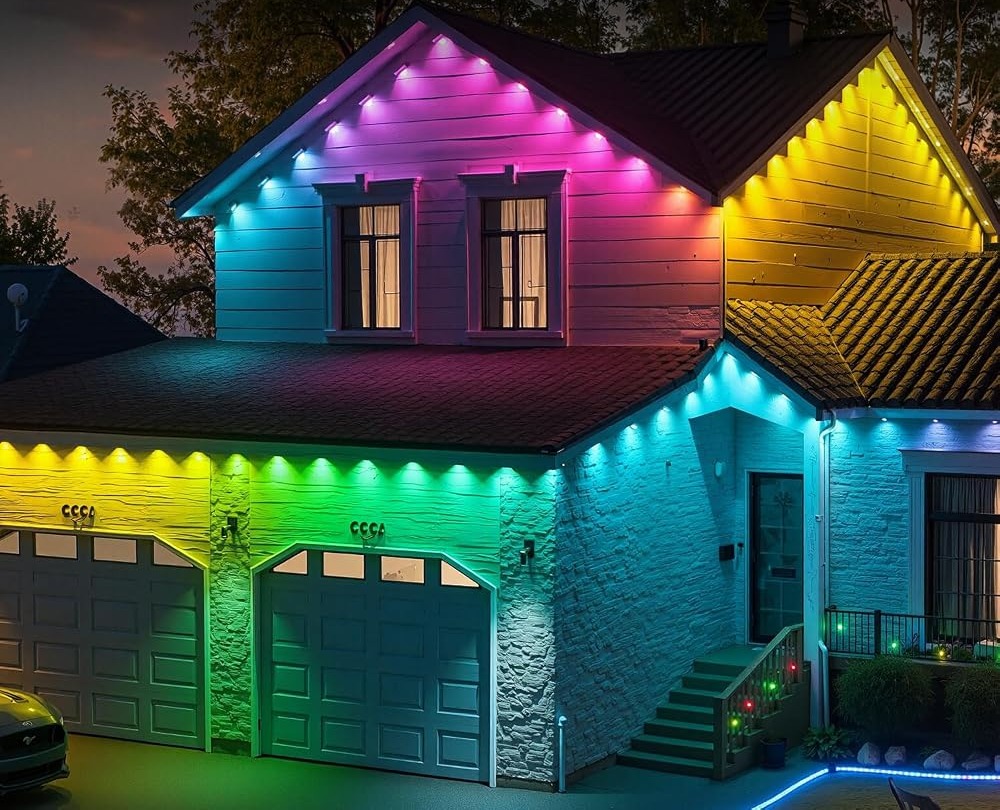
The first difference is scale. Battery-powered decorations are usually short strands or small accent pieces, because a battery pack can only feed so many LEDs before the runtime suffers. A hardwired run has no such ceiling in the same sense: this set covers 100 feet with 50 RGB+IC LEDs from a single adapter. If you want to outline a whole roofline, wired power is the realistic category.
The second difference is upkeep. A battery setup means watching charge levels, swapping cells or plugging a pack in, often in awkward weather. Miss a charge and the display simply is not there on the night you wanted it. A wired set plugged into an outlet removes that routine. The seller includes a built-in timer in the app, so the lights can follow a daily schedule without daily attention.
The third difference is placement. Battery lights win here: you can put them on a fence, a tree or a balcony with no outlet in sight. A wired 24V set only works where power already reaches.
Power and Safety in Practice
The hardwired set here runs on a low-voltage 24V system, and the seller notes safety around children and elderly. That is a documented point, not a safety certification. The adapter still plugs into a household outlet and carries mains power on its input side, so it belongs in a dry, sheltered spot out of reach of standing water.
The seller rates the strip IP67 and calls the control box and adapter rainproof, with anti-UV material and an operating range of -4°F to 140°F (-20°C to 60°C). Treat that as a seller-stated rating. It does not mean the strip can go underwater or that the adapter can sit in a puddle. There is no battery option in the listing, so a nearby outlet is not optional.
If you are new to the voltage question, the LED vs incandescent outdoor lights guide explains why LED suits a long permanent run, and the permanent vs seasonal Christmas lights hub sets wired power against the yearly ritual of taking lights down.
A Quick Comparison Table
| Factor | Battery lights | Hardwired 24V set |
|---|---|---|
| Placement | Anywhere | Near an outlet |
| Runtime | Limited by charge | Continuous while plugged in |
| Typical scale | Small accents | Long roofline runs |
| Upkeep | Charge or replace cells | None day to day |
| Best for | Temporary, portable decor | Permanent eave lighting |
The table shows why the two categories rarely fight each other. Battery lights are for places power cannot reach; wired lights are for places you never want to think about again.

Making the Choice for Your Home
Start with the outlet. If there is a receptacle near the eaves, a wired set opens up a full 100ft run with per-pixel color control, 234 dynamic modes and 33 built-in scenes. The LotusLamp X app changes color and brightness and runs a built-in timer, and a remote is included. If there is no power nearby, a battery decoration may be the only practical option unless you are willing to run a new circuit.
The second filter is portability. Battery sets still have a place for a balcony or a spot the cable cannot reach, but they rarely replace a full roofline outline. Mounting is the third filter. The set supports both self-adhesive backing and screw-in fixing, which suits smooth fascia and rougher surfaces. The adhesive vs screw mounting guide compares the two. For a broader view of how a wired eave run fits an exterior plan, the permanent lights vs spotlights comparison shows where a colored outline sits alongside fixed fixtures.
What to check before you buy
Choose wired if you want a long, permanent display and have power nearby. Choose battery if you need portability or have no outlet. Skip both if local rules forbid exterior fixtures.
- Confirm an outlet is close to the intended run.
- Plan a sheltered spot for the controller and adapter.
- Treat IP67 as the seller’s stated rating.
- Treat the 50,000-hour figure as a listing estimate.
- Remember there is no battery option in this listing.
FAQ
Can I add a battery pack to make it portable?
The listing describes a wired 24V system with an adapter and no battery operation. There is no support in the product details for running it from a pack.
Is 24V safer than a battery decoration?
The seller notes safety around children and elderly for the 24V system. That is the documented claim. A battery decoration has its own low-voltage profile, so neither should be treated as certified safe without checking.
What happens if the power goes out?
The lights stop until power returns, since there is no battery backup. The built-in timer resumes on its schedule once the adapter is powered again.
Battery vs hardwired outdoor lights usually resolves itself once you find the outlet. If you have power at the eaves and want a permanent run, view the RGB+IC eave lights on Amazon.
Views: 0