As an Amazon Associate I earn from qualifying purchases. Links below are affiliate links, which means I may earn a commission at no extra cost to you.
Smart lights vs dumb lights outdoors is a choice about what you want from a display after the ladder is put away. A simple light does one thing: it comes on when you switch it. A smart set can change color on a schedule, follow a scene, react to music and be adjusted from a phone. This 100ft RGB+IC eave run is firmly in the smart category, but it also ships with a remote so it still works when the phone is not in reach. This guide looks at what smart control genuinely adds outside and where a simple setup is the more honest fit.
Quick answer
Smart lights vs dumb lights outdoors comes down to variety and routine. A basic set gives you on, off and a fixed look. A smart set adds color changes, scenes, schedules and music sync, with a remote as a fallback. If you want a display that changes with the calendar without re-wiring anything, smart wins; if you want one steady glow, simple is enough. Check the current price on Amazon.
Smart Lights vs Dumb Lights: The Outdoor Difference
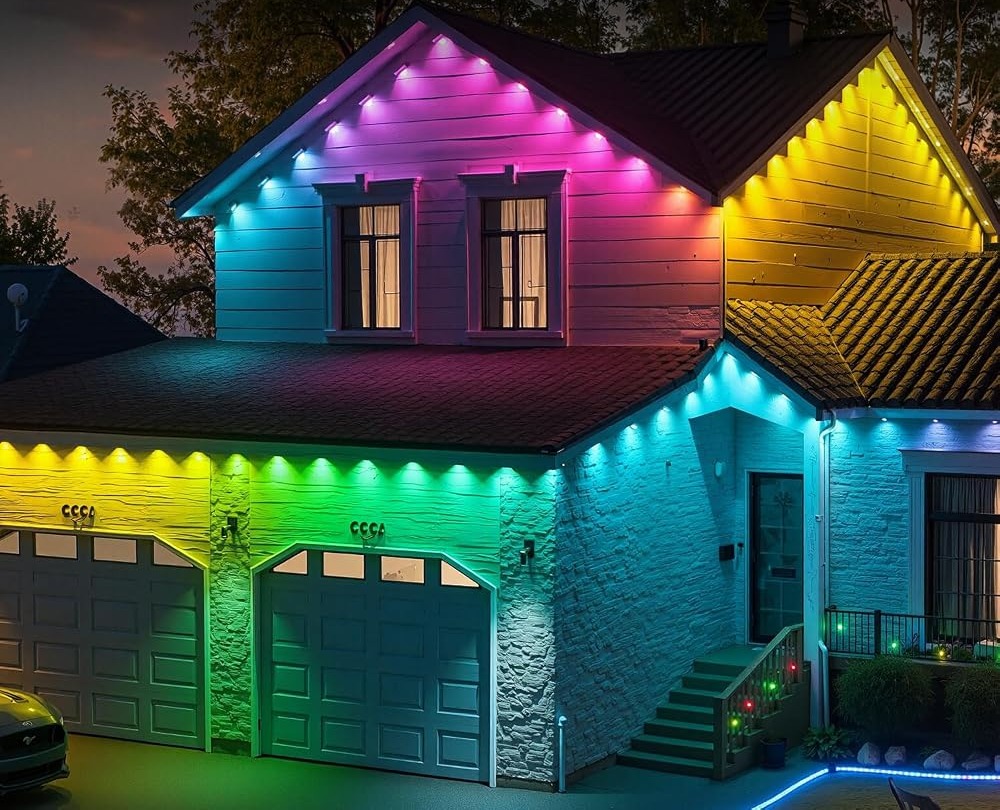
The first gain is scene changes. With a basic outdoor light, the look is decided at installation: the bulb color is the color. A smart set stores multiple looks and switches between them in seconds. The 100ft run here covers 50 RGB+IC LEDs with individual-color control, so the line can show one tone or several at once. The seller lists 16 million DIY colors, 234 dynamic modes and 33 built-in scene modes, which is the raw material for a display that changes with the season.
The second gain is scheduling. The LotusLamp X app includes a built-in timer, so the lights can come on at dusk and go off at a set hour every day. That suits a homeowner who wants a consistent facade without touching a switch. A basic light can sit on a plug-in timer, but it cannot change what it shows.
The third gain is music sync. The app can make the lights respond to a beat, which turns a roofline into part of a party. It is a niche feature, but it shows the gap between the two categories.
A Practical Comparison
| Feature | Basic outdoor light | Smart eave set |
|---|---|---|
| On and off | Manual or plug timer | App, timer and remote |
| Color | Fixed | Up to 16 million, per pixel |
| Scenes | None | 33 built-in scene modes |
| Schedule | Plug timer only | Built-in app timer |
| Music response | None | Beat sync in app |
The table shows that smart control is mostly about options. If you will use them, they are worthwhile; if you will not, you are paying attention to features you ignore.
The Remote as the Honest Fallback
A frequent criticism of smart lighting is that it fails when the phone is unavailable. A physical remote is included here, which covers basic on, off and look changes without opening an app. That matters outside, where you may be in the yard with wet hands or the phone may be indoors. That kind of fallback is why a smart set still makes sense in a yard where the phone is not always in your pocket.
The heavier work still belongs to the app. Building a custom sequence, setting a gradient or syncing to music is a phone job. Individual-color control is what makes those scenes look varied rather than flat; if you are deciding whether to use that variety at all, the one color vs color changing outdoor lights guide compares a calm steady line with a flexible display. The point is that smart control only pays off when you choose to use it.
Support is a practical detail. The seller says to contact them through your order and will reply within 24 hours if something goes wrong.

Where Smart Control Fits the Exterior
Smart lighting only pays off on a display you keep up. A set that comes down each season gets less from an app than one that stays on the eaves. The permanent vs seasonal Christmas lights hub sets that trade-off out clearly. And if you are still choosing between a clean outline and a draped look, the eave lights vs string lights comparison covers the two appearances before control enters the picture.
For the wider framework, the complete buying guide to permanent outdoor lights places smart control alongside length, weather rating and mounting. Power is the shared limit: this is a wired 24V system needing a nearby outlet, so smart features do not free you from planning the cable route.
What to check before you buy
Choose smart if you will change colors, run schedules or use scenes. Choose a basic set if you want one steady look with no learning. Skip both if there is no outlet near the eaves.
- Confirm an outlet is close to the run for the adapter.
- Decide which scenes you will actually use.
- Plan a sheltered spot for the control box and adapter.
- Treat IP67 as the seller’s stated rating.
- Treat 50,000 hours as a listing estimate.
FAQ
Do smart lights work without a phone?
Basic control does. The remote handles on, off and simple changes, and the built-in timer runs a daily schedule. The phone is needed for colors, scenes, sequences and music sync.
Can I set the lights to come on at dusk?
The app includes a built-in timer for scheduled lighting. You set the times once and the run follows that routine until you change it.
Is a remote still useful with an app?
Yes. It is faster for a quick change and works when the phone is elsewhere or the app is not open, which is common when you are outside.
Smart lights vs dumb lights outdoors resolves to how much variety you will use. If you want scenes, schedules and a remote fallback on one 100ft run, see the 100ft set on Amazon.
Views: 0