As an Amazon Associate I earn from qualifying purchases. Links below are affiliate links, which means I may earn a commission at no extra cost to you.
The promise behind all weather outdoor lights is that one set stays put through the whole calendar. The reality is more specific: a product has an operating range, a material that handles sun, and an ingress rating that describes water exposure. This 100ft permanent eave set lists -4°F to 140°F (-20°C to 60°C), anti-UV material and a seller-stated IP67 rating for the strip. In this guide I translate those lines into what an outdoor run actually faces from July heat to January cold, and I name the limits so you can decide if a fixed set suits your climate.

Quick answer
All year means the strip is built to operate across -4°F to 140°F and to resist sun and rain in normal outdoor exposure. It does not mean the adapter can sit in a puddle or that any storm is covered. The seller-stated IP67 rating applies to the strip; shelter the rainproof box and adapter. Check the current price on Amazon.
All weather outdoor lights: reading the temperature span
A temperature range is the first line to check, because it sets the boundaries of the whole discussion. The seller gives -4°F to 140°F for this 100ft RGB+IC set. The low end covers freezing winters in much of the country; the high end accounts for a strip mounted under a dark eave that bakes in summer sun. That upper figure is easy to overlook, yet a roofline can be far hotter than the air temperature on a clear afternoon.
What the span does not do is guarantee identical behavior at both extremes. Electronic parts and adhesives respond to cold and heat differently, and a listing range describes intended operation rather than a lab result you can reproduce. For a careful reading of the water side of the rating, what the IP67 rating actually covers separates the strip from the power end. Pair that with the temperature span and you have the real outdoor envelope.
Heat and sun are the harder test
Most buyers worry about rain. In practice, summer exposure is the tougher opponent for a permanent mount. The seller lists anti-UV material, which is there to slow the breakdown that comes from long hours of direct light on a south or west eave. The UV resistant material explanation goes into why this matters and how to think about a sun-facing run.
Heat also shapes where you mount the strip. A light-colored soffit reflects warmth; a dark metal fascia holds it. Neither is forbidden, but both are worth noting during planning. The strip itself is rated to 140°F, and the 24V system keeps the run low voltage, but the adhesive backing has its own real-world behavior on a hot surface. Press it onto a clean, dry panel and the bond has the best chance of lasting through the season.
Cold weather and the winter months
Winter brings a different set of questions. The low end of -4°F covers typical cold snaps, and the seller notes the strip is meant for outdoor use all year. Installation is where cold makes life harder: adhesive is less forgiving when the mounting surface is cold or damp, so a careful installer plans the fix before a freeze. The cold weather installation tips walk through what to expect and how to sequence the job.
Through the winter, expect the strip to handle cold, rain and the occasional frost within its stated range. What it does not handle is being trapped under standing water or buried in ice at a low corner. Keep the mounting clear of gutters that overflow, and make sure the control box and adapter stay under cover. Those two habits do more for winter reliability than any single spec on the box.
What all year really asks of the install
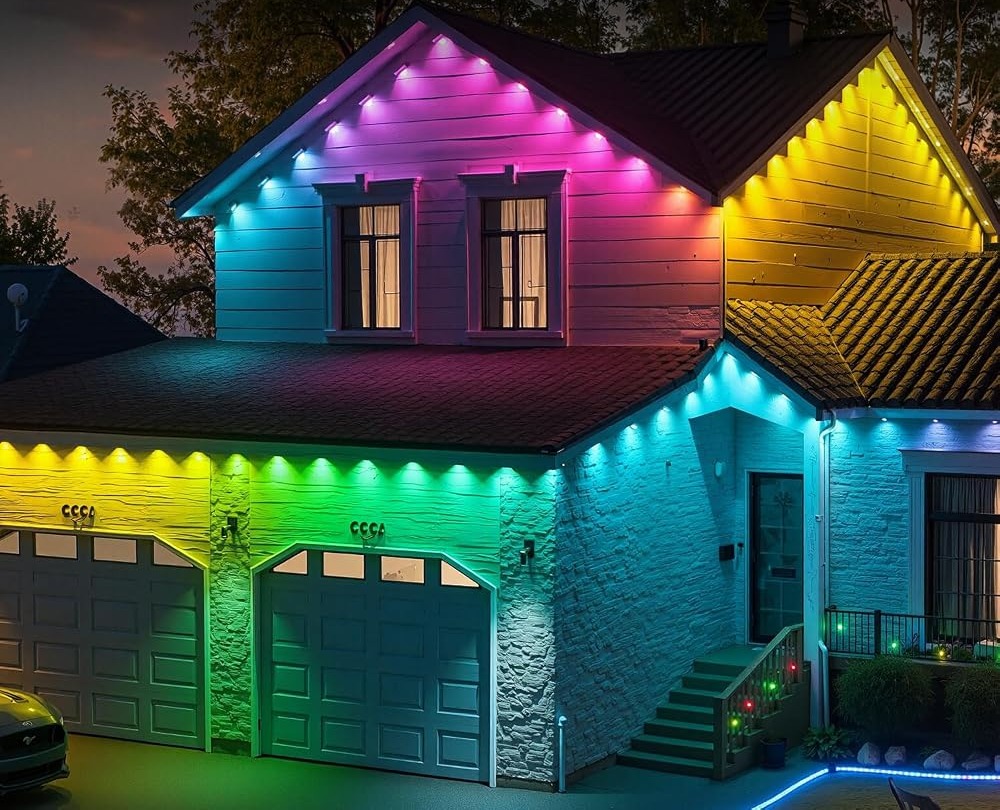
A permanent set is a commitment to one location, which is why the install matters more than any one rating. Use the self-adhesive backing for a clean run, then add the screw-in fixing at corners and exposed stretches. That combination handles wind pull and temperature-driven movement better than adhesive alone. The rainproof box and adapter belong in a sheltered spot with a nearby outlet, and the cable should be tidy rather than taut.
One honest drawback: a fixed strip cannot be brought inside during a severe storm, the way a seasonal string can. You accept the weather where you mount it. The seller-stated IP67 strip, anti-UV material and wide temperature range make that trade reasonable for a normal eave, but they are not a promise for every condition. The listing’s up-to-50,000-hour figure is worth reading as an estimate; what a 50,000-hour rating means puts that number in perspective. See the 100ft set on Amazon if a permanent, all-season run is what you want.
What to check before you buy
This set suits a homeowner committed to one sheltered eave through every season. It is a weaker fit if you want to take lights down when the weather turns.
- Check -4°F to 140°F against your local extremes.
- Confirm anti-UV material on a sun-facing mount.
- Treat IP67 as the seller’s rating for the strip alone.
- Keep the rainproof box and adapter sheltered near an outlet.
- Plan both adhesive and screws for a lasting fix.
- Read the 50,000-hour life figure as a listing estimate.
FAQ
Does all weather mean it works in any storm?
No. It means operation across the stated temperature range and normal outdoor exposure. Severe weather, standing water and physical damage are outside what a rating can promise.
Can it stay up through winter?
The seller lists operation down to -4°F, so cold is within range. Mount where water will not collect, and shelter the power end through the wet months.
What shortens the life of a permanent set?
Poor mounting, direct exposure of the adapter and a sun-facing run without anti-UV protection are the practical factors. The 50,000-hour figure is a listing estimate, not a guarantee.
All season performance comes down to a few verified details used well: a wide temperature span, anti-UV material, a seller-stated IP67 strip and a sheltered power end. Add a careful mount and the set has what it needs for year-round eave lighting. View the RGB+IC outdoor lights on Amazon.
Views: 0