As an Amazon Associate I earn from qualifying purchases. Links below are affiliate links, which means I may earn a commission at no extra cost to you.
Budget christmas window decorations fail for a reason that has nothing to do with money. They fail because of light. A window is a black rectangle for fourteen hours a day in December, and anything hanging in it is backlit by nothing. Plastic that looks fine on a shelf turns gray and flat against dark glass. Get the light and the shape right and a modest window reads expensive. Get them wrong and a cart full of ornaments still looks like a cart full of ornaments.
Quick answer
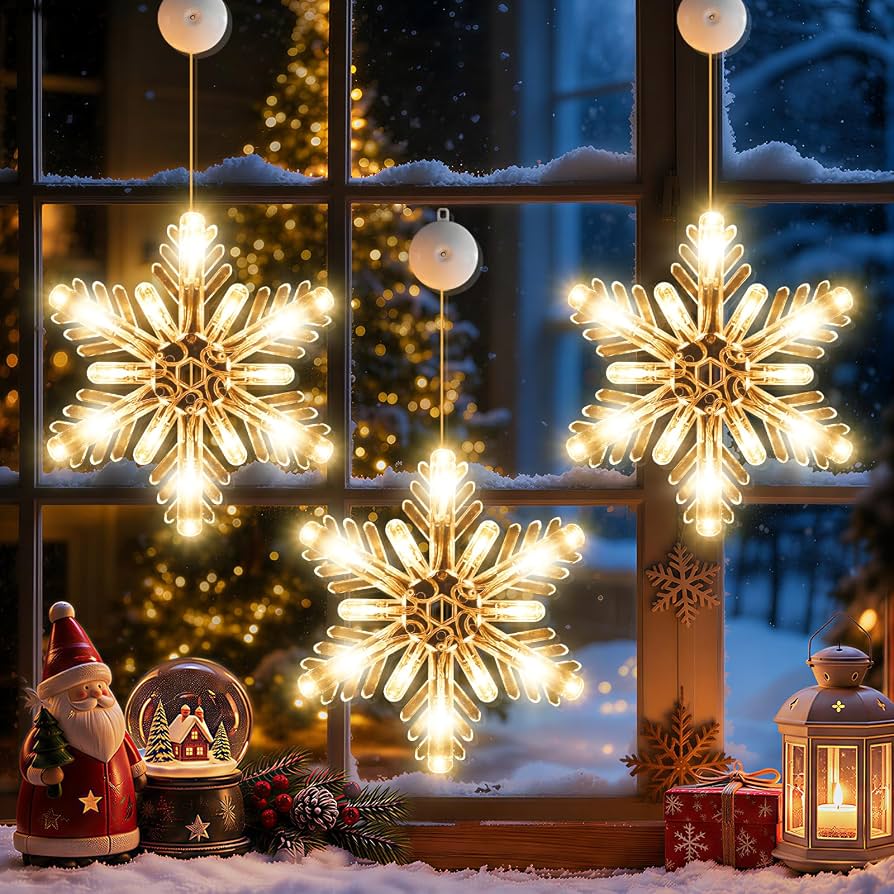
Spend on the thing that emits light, save on everything else. A warm-white piece with its own battery and timer does more for a window than a pile of unlit ornaments, and once the timer is set it runs itself until the cells give out. Check the current price on Amazon for the cordless version; the rest of this page is about where budget actually shows.
Budget Christmas Window Decorations: Where Cheap Shows
There is a short list of giveaways, and most of them are visible from the sidewalk.
| Element | Reads cheap when | Reads fine when |
|---|---|---|
| Material | Thin plastic with visible seams | Matte finish, one clean shape |
| Color | Cool blue-white mixed with warm | One temperature, start to finish |
| Quantity | Many small mismatched pieces | Three of the same thing |
| Attachment | Tape, visible clips, sagging string | Suction cup or nothing visible |
| Light | Unlit ornaments at night | Lit shapes, steady or twinkling |
The pattern is consistency. Cheapness is not a material; it is a mismatch. Three identical snowflakes at the same height look deliberate. The same three snowflakes plus a star, a reindeer and a strand of tinsel look like a drawer was emptied onto the glass.
One good piece beats five weak ones
This is the single most useful rule in budget decorating, and it is the one people break first. A window with one well-lit shape reads as a decision. A window with six weak shapes reads as a shortage.
The math favors restraint. Three pieces of one design fill a standard window evenly, need one mounting method, and take ten minutes to hang. Six mixed pieces need six different fixing points, sag at different angles, and double the time you spend on a ladder. If your budget only stretches to one set, buy one set and leave the rest of the window alone.
Then repeat the shape elsewhere. The same snowflake on a kitchen window and a hallway mirror ties the house together without buying a second design, and repetition is what people read as a theme. That is the direction the 2026 decorating trends describes: fewer shapes, warmer light.
Cost per season, not cost per item
The number on the tag is the least interesting number in this decision. What matters is how many Decembers the thing survives.
A decoration that lasts five seasons does five times the work of one that cracks in January, whatever the two cost. That reframing changes what you buy. Thin wire, glued joints and painted finishes are the parts that fail; a molded shape with a sealed battery compartment is the part that survives. Storage matters just as much, because a box in a damp garage will ruin a good piece faster than daily use will.
Count the seasons before you count anything else. If a piece will not survive three, it is not a budget purchase; it is a rental.
One recurring cost is worth naming: cells. A battery set on a 6-hour timer runs every night, and nine AAA batteries are a consumable, not a one-time purchase. The math on what window lights cost to run explains why the batteries matter more than the electricity. Buy a spare pack in November and you will not be hunting for one on December 24.

What to reuse, and what to retire
Reuse is where budget decorating is won, but not everything deserves a second year.
Keep: solid shapes with no moving parts, anything with a battery compartment that still closes cleanly, and plain ribbon or twine that has not faded. Replace: anything with a cracked lens, a corroded contact, or a finish that has gone chalky. Retire: strands where half the bulbs are out, because a half-lit window is worse than an unlit one.
Store by window, not by type. One bag per window, labeled, so next November you are hanging decorations rather than sorting them. If you are unsure whether an older set is still safe to run, the safety guide for lights on glass covers the checks worth doing.
Who should skip the budget route
If you want a window that stops traffic, budget decorating will not get you there. Statement displays need volume: multiple sets, layered shapes, something at three heights. That is a different project with a different spend.
Skip this approach too if you have one large bay window and a small budget. Three pieces will look lost across eight feet of glass, and stretching them thin is exactly how a good set starts to look cheap. Use one pane, do it properly, and leave the other panes dark. If the calendar is the constraint rather than the money, when to put up Christmas lights covers timing.
What to check before you buy
- Indoor rating. Suction-cup sets are for interior glass, not porch rails.
- Batteries not included. Three AAA per piece; nine cells for a three-piece set.
- One color, fixed. Warm white does not shift to multicolor later.
- Clean smooth glass. Texture and grease defeat a suction cup every time.
- Timer included. Six on, eighteen off, starting when you switch it on.
FAQ
Is it worth buying decorations after Christmas?
Only for pieces you would have bought anyway. The week after is a good time to add a second set of the same design, and a bad time to buy a shape you have no plan for.
How many pieces does one window need?
Three for a standard window, spaced evenly across the upper half. A narrow window takes two, and a wide bay takes two sets rather than one stretched thin.
Do unlit decorations ever look good?
In daylight, yes. At night, an unlit window reads as absent. If the window faces the street, prioritize the part that glows and treat the rest as filler.
Bottom line
Budget window decorating is a discipline, not a compromise: one shape, one color, one mounting method, and light where the street can see it. Three pieces that run themselves will outlast and outread a box of mixed ornaments, and they pack into a single bag in January. See the three-piece set on Amazon if you want the version that does the lighting for you.
Views: 0