As an Amazon Associate I earn from qualifying purchases. Links below are affiliate links, which means I may earn a commission at no extra cost to you.
If you are planning eave lights for a house, the hardest part is usually deciding where the first run goes. A whole exterior can feel like a puzzle of corners, doors and outlets. The simpler approach is to treat the front roofline as the backbone, mount one continuous 100ft set along the fascia, and let that outline define the house before you think about the porch, garage or backyard. This guide walks through that starting point, where the run reaches, and the limits to accept up front. I stay inside the product listing and avoid invented specifications.

Quick answer
Start with the front roofline: a single 100ft run of 50 RGB+IC LEDs gives you an even outline you can change by app or remote. Mount it along the fascia, plan the control box near an outlet, then add other zones only after the front reads the way you want. Check the current price on Amazon.
Eave lights for a house: start at the roofline
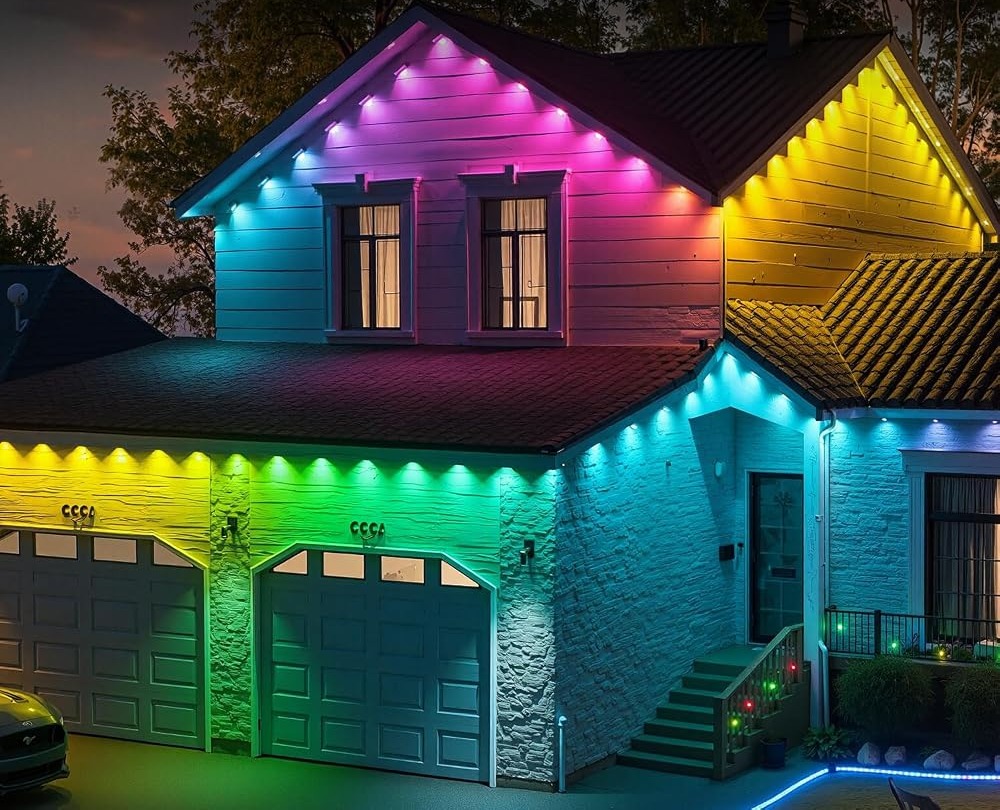
The front elevation is the right first move for most homes. It is the face neighbors and guests see, and a continuous line along the eaves gives the eye a clean edge to follow. With a 100ft run carrying 50 individually controlled pixels, the spacing works out to about one LED every two feet, which is even enough to read as a line from the sidewalk rather than a string of isolated dots.
Per-pixel control matters here. Standard RGB lights show one color at a time, but RGB+IC lets each pixel run its own color, so chasing and gradient effects travel along the fascia instead of blinking in unison. The listing includes 234 dynamic modes and 33 built-in scene modes, though for a front elevation a slow single-color sweep usually looks calmer than a fast rainbow. Start with one restrained color, then experiment once the run is up.
Follow the fascia before adding other zones
Once the roofline is set, resist the urge to light everything at once. Work outward in a deliberate order.
| Step | Area | What the run does |
|---|---|---|
| 1 | Front roofline | Sets the main outline and visual anchor |
| 2 | Porch or entry | Defines the welcome point under the outline |
| 3 | Garage door | Frames a second large plane |
| 4 | Side and rear | Extends the scheme only if the run reaches |
That order keeps decisions simple. The porch is the natural second zone, and the guide to porch light ideas with a permanent run covers how to keep that entry welcoming without competing with the roofline. The garage is a bigger surface, and framing a garage door and driveway shows where to place the run and how to keep the control box clear of the vehicle path.
Plan power and mounting on the front run
Two practical decisions shape the install more than color does. First, power: this is a wired 24V system, so the adapter needs a nearby outlet and the rainproof control box should sit under cover, out of direct water. Map the outlet location before you stick anything down, because the run should end near the power source rather than the other way around.
Second, mounting: the set offers a self-adhesive backing and screw-in fixing. Clean, smooth fascia suits the adhesive; a rough or painted surface is better with screws. Think about which you will accept on a house you may repaint later, since removal is easier with screws. The seller rates the strip IP67, the control box and adapter are called rainproof, and the material is anti-UV with a stated -4°F to 140°F range. Treat each as a description of normal outdoor use, not a guarantee.
How far one 100ft run will reach
A 100ft run covers a surprising amount of a typical single-story front, but it is not infinite. Measure your fascia with a flexible tape, follow the corners, and add a little slack for turns. If the front elevation alone eats most of the run, leave the backyard for a separate plan; the comparison of backyard string lights and a fixed eave run explains where each approach fits and how they can complement one another.
The honest drawback is flexibility at corners. The strip bends gently around a turn, but tight kinks are worth avoiding, and each corner consumes a little length. If your house has many projections, expect to prioritize. Who this suits: an owner who wants one clean front outline from a single kit. Who should skip: someone who needs to wrap a large, complex perimeter on day one.
What to check before you buy
Good results come from measuring twice and deciding how much of the exterior matters most. This set suits a homeowner who can mount the strip under an eave and shelter the power end; it is weaker if the only outlet sits far from the roofline.
- Measure the full front fascia, including corners, before ordering.
- Confirm an outlet is close enough for the 24V adapter.
- Plan a sheltered spot for the rainproof control box.
- Choose adhesive or screws based on your fascia surface.
- Treat the IP67 strip rating as seller-stated, not a promise in standing water.
- Read the up-to-50,000-hour figure as a listing estimate.
FAQ
Should the roofline really come first?
Yes for most homes. It is the most visible edge and it sets the scale for every later zone. Starting elsewhere tends to produce a patchwork look, whereas one continuous front outline gives the other areas a reference point to match.
Can I add the porch and garage later?
You can, but one 100ft run is finite. Plan the whole front on paper first, then decide which secondary zone fits within the length. It is easier to leave a short gap than to stretch a run past its limit.
Do I need screws if the backing is adhesive?
On clean, smooth fascia the adhesive backing is often enough. On rough, dusty or freshly painted surfaces, screws add security and make future removal cleaner. The set includes both fixing methods, so the choice depends on your surface.
A single 100ft RGB+IC run is a sensible first step for most exteriors: outline the front roofline, establish one calm color, then build out toward the porch and garage only if the length allows. Accept the honest limits, measure carefully, and the result looks intentional rather than improvised. If that plan fits your house, see the 100ft set on Amazon.
Views: 0