As an Amazon Associate I earn from qualifying purchases. Links below are affiliate links, which means I may earn a commission at no extra cost to you.
A hall is the one space where you cannot afford to lose an inch: 36 inches wide, three doors, and no floor area worth mentioning. Hallway christmas decorations also get judged in the worst conditions: you walk into them in the dark, at speed, usually at 2 a.m. That rules out most of what works in a living room and leaves two things that matter, the door swing and the height of the light.

Quick answer
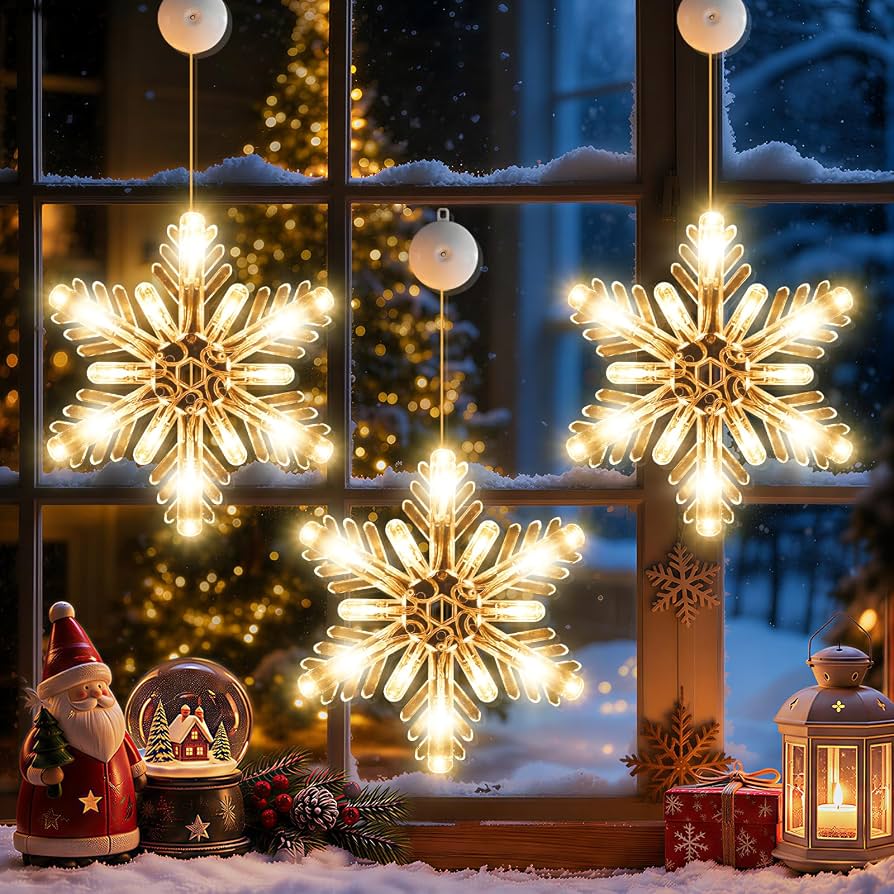
Decorate up, not out. Three small pieces in a vertical column on whatever glass the hall has, hung above eye level or below it, so a 2 a.m. trip does not end in a face full of light. Nothing on the floor, nothing inside a door’s swing. Check the current price on Amazon if the hall has glass to hang on.
Hallway Christmas Decorations: Measure the Swing First
Before anything goes on a wall or a door, measure how far each door opens.
A standard interior door is 30 to 32 inches wide and opens 90 degrees, which means a quarter circle with a radius equal to the door’s width sweeps through the space every time someone walks in. Nothing goes inside that arc.
- The hinge side is safe. The wall behind the open door is dead space, and the best spot in the hall for anything that sticks out.
- The handle side is not. That is where a door edge travels fastest.
- Glass door panels are the exception. A piece flat on the glass adds no depth, so the swing passes over it.
Measure from the hinge and add two inches; doors settle and open further than the drawing says.
Vertical, because horizontal is already full
A hallway has no run of wall long enough for a horizontal row. It does have height, and height is free.
Stack three pieces in one column: 60 inches, 48, 36, evenly spaced on the same center line. The column reads as one object from the far end of the hall, which is where anyone actually sees it; a row reads as three objects crammed between two frames.
If the hall is short, use two and drop the bottom piece. The bedroom guide uses the opposite logic and hangs low, because there the viewer is lying down.
Light at 2 a.m. is a different problem
Every hallway light looks fine at 7 p.m. and wrong at 2 a.m., when your eyes are dark-adapted and you are moving on autopilot.
Avoid the band from 48 to 68 inches off the floor. That is eye level for most adults, and a piece there shines into a dark-adapted face. Two placements work instead:
- Above 72 inches. The light grazes the ceiling, so you get a glow without a bright object in your sightline.
- Below 40 inches. Low enough to light the floor, which is what you need to see.
One rule beats both: keep the glass out of the line between a bedroom door and the bathroom door.
Where the glass actually is
Suction cups need flat, smooth glass, and a hallway does not always have any.
| Surface | Verdict | Why |
|---|---|---|
| Sidelight beside the front door | Best | Tall glass, right height, seen on arrival |
| Glass panel in an interior door | Good | Flat, and safe from the swing |
| Transom above a door | Good, hard to reach | Out of the way, but the switch is a stretch |
| Hall mirror | Good | Same rules, catches you on the way out |
| Painted wall or door | No | Nothing for a cup to grip |
| Frosted or textured glass | No | Air leaks past the texture |
Frosted glass is the trap: common in halls and bathroom doors because it is private, and exactly what a cup cannot hold. Run a fingernail across the pane: if you feel texture, the cup will not seal.
The timer does the work in a hall
Hallways rarely have a useful outlet, and a cord along a corridor is a trip hazard in the room where people walk without looking. Battery power is not a compromise here; it is why the display is possible.
The timer runs six hours on and eighteen off, starting when you switch it on. Set it at 4:30 and the hall is lit when you come home in the dark, dark again at 10:30, when nobody walks through.
Be clear about what that means: a six-hour block is not a night light, and if you want a glow at 3 a.m. this set will not provide it. That is the trade for a corridor that returns to darkness by itself.
If the hall opens into a study, the video call background guide covers what a lit pane does on camera, and kids’ room lighting is the version where a child has to reach the switch.
What to check before you buy
- Indoor use only. Interior glass. Not a porch or an exterior door panel.
- Nine AAA cells. Three per piece, not included. Buy them before you hang anything.
- Clean, smooth glass. Frosted, textured, or painted surfaces will not hold.
- Warm white, fixed. One color, no remote, no dimmer.
- Six on, eighteen off. A fixed block, counted from the switch.
- Ambience, not corridor lighting. Thirty-six LEDs across three pieces light the shape, not the floor.
Who should skip it: anyone whose hall has no glass, common in older apartments; anyone with frosted panels only; and anyone who wants a light on all night, which is a night light’s job. If the corridor ends in a dining room, dining room window decorations applies these rules to a wider wall.
FAQ
Can I hang these on a door?
On the glass part, yes, and a panel in an interior door is a good spot because a flat piece adds no depth for the swing to catch. Never hang anything near the handle, where a hand and a hip arrive at speed.
Will a piece survive a door being slammed?
The set weighs almost nothing and sits flat on the glass, so the swing passes over it. The bigger risk is the frame flexing: check that the cup is not bridging frame and pane, because that gap leaks air.
How high should hallway decorations go?
Above 72 inches or below 40. The band between is eye level, and a bright object there at 2 a.m. is unpleasant at close range.
Bottom line
A narrow hall rewards restraint: one vertical column on the glass, above or below eye level, clear of every door swing, lit on a timer. Three pieces is the whole display, and it hangs in ten minutes with no nail and no cord across the floor. See the three-piece snowflake set on Amazon if the hall has a pane to take it.
Views: 0