As an Amazon Associate I earn from qualifying purchases. Links below are affiliate links, which means I may earn a commission at no extra cost to you.
Every listing says LED, and the numbers do not line up. One promises 36 LEDs, another 100, another says “super bright” and gives no figure at all. None of those numbers mean what a shopper assumes, which is why two sets that look identical in a photo can read completely differently through a pane. LED Christmas window lights come down to five specs, and four of them are usually buried below the fold.
Quick answer
Check the total LED count across the set, the color temperature, the cell type and whether cells are included, how the timer starts, and what the light mounts to. Everything else is packaging. Check the current price on Amazon for a set that answers all five honestly.
LED Christmas window lights: the five specs that matter
- Total LED count across the set, not per piece. It tells you how continuous the shape looks from outside.
- Color temperature. Warm white or cool white, and whether you can change it. You usually cannot.
- Cells. Size, how many per piece, and whether they ship in the box.
- Switch and timer behavior. Where the switch sits, and what starts the cycle.
- Mounting. Suction cup, adhesive, or hook, and what surface each one tolerates.
Most of these are permanent. A color you dislike and a timer that starts at the wrong hour cannot be fixed after delivery, which is why they belong in the buying decision rather than the setup. Skip this whole format if you want dimming or a color you can change; nothing in this category offers either.
LED count is about spread, not brightness
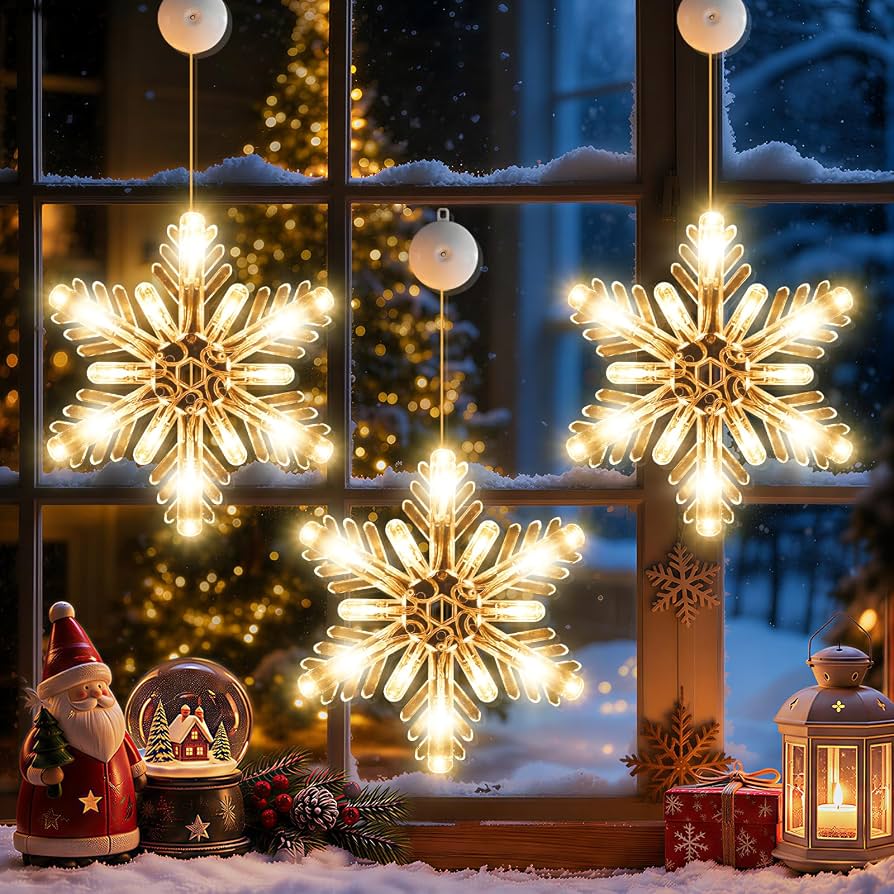
A count tells you how many points of light are packed into the shape. With thirty-six across three pieces, the array is close-set: the dots merge into a coherent silhouette at a few paces, which is what you want in a window. A long strand with a much higher count spreads the same density over several meters of wire, and reads as separate points.
Brightness per bulb is a different number, and most listings never state it. Treat count as a measure of evenness, not of how much light lands on the floor. Decorative sets are for the view from the street.
Warm white, cool white, and the wall behind them
Warm white sits at the amber end, close to the color of an old incandescent bulb. Cool white runs blue and reads like snow and ice. Both are legitimate; they fail in different rooms.
Warm white flatters red brick, cream siding, timber trim, and anything with a fireplace in it. Cool white sharpens a modern white wall and goes slightly green against beige. If your room has warm woodwork, warm white is the safer call, and it is the reason most window displays in older houses look better than the ones next door.
Neither option dims. There is no dial on a set like this, so the only brightness control is how much of the window you cover.
This format suits anyone lighting a window they do not own: a rental apartment, a dorm room, a storefront pane with no socket behind it. It does not suit a room that needs the window to work as a lamp.

Batteries, switches, and the timer
| Spec | What to look for | Why it decides the result |
|---|---|---|
| Cell size | AAA, three per piece | Sold everywhere, easy to swap mid-season |
| Included? | Often no | A set without cells is not ready to hang |
| Timer | Six on, eighteen off, starts at the switch | The reason it can run unattended all December |
| Modes | Steady and twinkling | Twinkle suits a tree, steady suits a window |
| Mount | Suction cup with the battery in the hook | No second box, no cord, no nail |
| Rating | Indoor use | Exterior glass is outside the design |
The switch position matters more than people expect. If it sits on the back of the piece, you will be lifting the unit off the glass every night. If it is reachable on the hook, the timer becomes genuinely hands-off.
What the listing numbers will not tell you
There is no lumen figure, no runtime, and no per-piece count on most of these sets. That is not a trick, it is the category: a decorative window piece is judged on shape and placement, not photometrics.
So work from what is verifiable. Three AAA cells per piece means a modest draw. A six-hour nightly cycle means a set of fresh alkalines carries you for weeks, and cold glass shortens that. Thirty-six LEDs across three pieces means a soft silhouette, bright enough to read from the sidewalk and not bright enough to light a room.
If counting pieces is the harder question, how many Christmas lights per window gives the spacing rule, and why cordless beats corded for windows explains the power side.
What to check before you buy
- Indoor rating. Confirm it, then keep the set on interior glass.
- Cells not included. Three AAA per piece. Buy them with the lights.
- One fixed color. Warm white cannot be switched cooler.
- Timer starts at the switch. Set that moment to match dusk.
- Surface match. Clean, smooth, untextured glass only.
- Decorative brightness. Not task lighting, and not sold as such.
For the broader picture on shapes and mounting, the complete guide to Christmas window lights covers what sits behind these five specs.
FAQ
Is a higher LED count always brighter?
No. Count describes how many points of light are spread across the design. A high count on a long strand can look dimmer per area than a lower count packed into a compact shape. Density matters more than the headline figure.
Can I mix warm and cool white in one window?
You can, and it usually looks like a mistake. Two temperatures in one frame compete instead of cooperating. Pick one for the whole window and use it consistently across every piece.
Does the timer reset if I switch it off?
Yes. The cycle begins each time the unit is switched on, so switching off mid-evening restarts it the next time you press the switch. Choose your switch-on hour and leave it alone.
Bottom line
Five specs decide whether an LED window set looks right: count for evenness, color for the room, cells for the season, timer for the routine, mount for the glass. Everything else is noise. View the warm-white set on Amazon if those five line up with what your window needs.
Views: 0