As an Amazon Associate I earn from qualifying purchases. Links below are affiliate links, which means I may earn a commission at no extra cost to you.
Most shoppers compare outdoor lights by color and length, then discover the power system only when they start planning the install. Low voltage outdoor lights work differently from a household fixture, and the difference shapes where you can mount them and how the run behaves over a long eave. This 100ft set uses a 24V system, and the seller notes safety around children and elderly family members. This guide explains what 24V means in practice, how it pairs with the rainproof adapter and control box, and what the honest limits of a wired low-voltage run are.

Quick answer
A 24V system is a low-voltage, wired setup: the adapter steps power down for the long LED run, and the seller highlights safety around children and elderly. It is not battery powered, so an outlet is still required. Keep the rainproof adapter and box sheltered, and treat the strip’s IP67 as the seller’s stated rating. Check the current price on Amazon.
Low voltage outdoor lights: what 24V changes
Voltage describes the electrical pressure pushing current through the run. A 24V system operates well below household line voltage, which is why sellers describe it as low voltage and why this listing calls out safety around children and elderly. For a long exterior strip, the lower figure also suits a run that travels along an eave and around corners.
What it does not mean is cordless freedom. This is a wired product: the included adapter connects to a nearby outlet and feeds the control box, which then drives the 50 RGB+IC LEDs along the 100ft strip. You still need to plan an outlet location and a tidy cable path. The benefit is a system intended for exterior use at a low operating voltage, not a light you can place anywhere without power. The listing gives no wattage figure, so I will not invent one here.
The adapter, the box and the outlet
The power end is where low-voltage practicality meets weather. The seller describes both the control box and the adapter as rainproof, which suits a covered outdoor location. Here is how the pieces fit.
| Piece | Role | Practical note |
|---|---|---|
| 24V adapter | Steps power down for the run | Keep sheltered, dry, near an outlet |
| Control box | Drives the LEDs and controls | Mount under cover, easy to reach |
| LED strip | 50 RGB+IC LEDs over 100ft | Seller-stated IP67 rating for the strip |
The table keeps the categories honest. The strip carries the IP67 rating; the box and adapter are rainproof, so they belong under the eave rather than out in the open. That distinction is explained in more detail in what the IP67 rating actually covers. A short, protected cable run from outlet to box is the goal, with connections off the ground where water collects.
Running 24V along a long eave
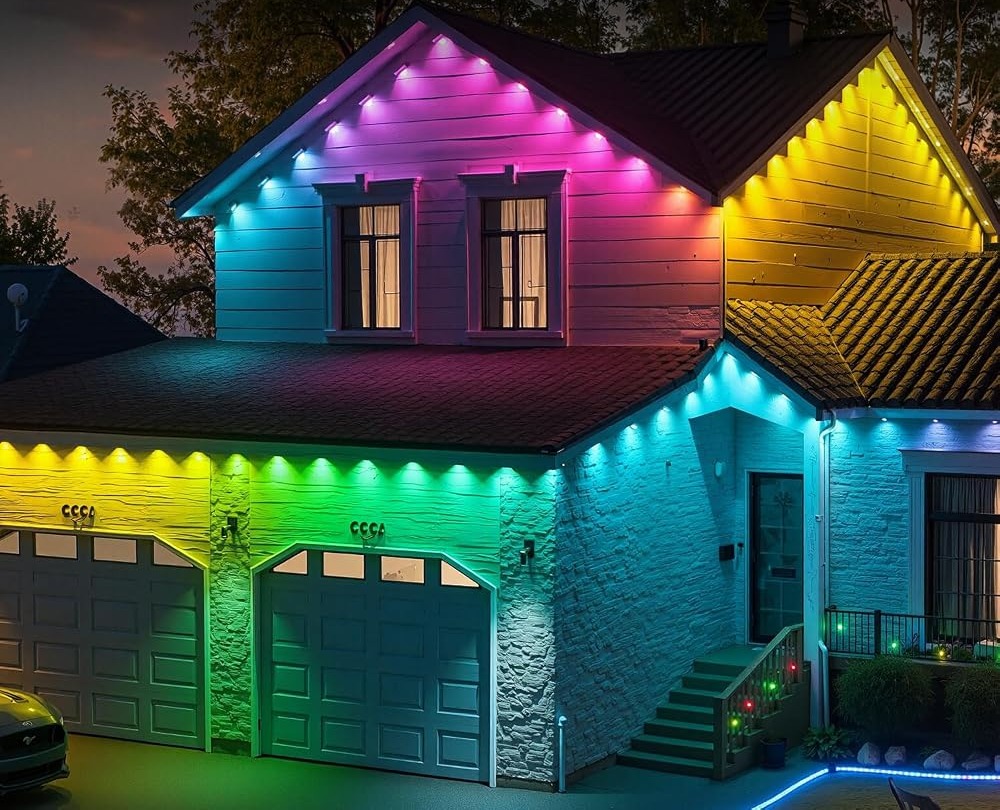
A 100ft run is a real physical job, and low voltage does not remove the need for a careful mount. Press the self-adhesive backing onto a clean, dry surface, then add the screw-in fixing at corners and exposed stretches. That combination keeps the strip from sagging or pulling loose as temperatures shift. Plan the route before peeling the backing, because repositioning a long strip is tedious.
The low-voltage design is one part of a longer service life, but it is not the whole story. Mounting quality, sun exposure and the sheltered placement of the power end all play a part, and what affects permanent outdoor light lifespan walks through those factors together. One honest drawback: the need for a nearby outlet can dictate where the run starts, and an extension across a walkway is rarely a good idea. Choose the outlet side of the house deliberately.
Weather, seasons and the power end
Low voltage and weather ratings work as a pair. The seller rates the strip IP67 and describes the box and adapter as rainproof, which fits normal outdoor exposure. A grounded, sheltered power end is what lets the system keep working through wet months, and a realistic rain or shine assessment explains where that protection ends in severe weather.
Through the year, the -4°F to 140°F range and anti-UV material cover temperature and sun, while the 24V system handles the electrical side. The result is a set designed to stay up across seasons rather than come down with the holidays. One set for every season makes the case for a permanent run over re-hanging lights each year. See the current listing on Amazon if a wired 24V eave setup suits your home.
What to check before you buy
This set suits a buyer with a convenient outlet and a permanent mounting plan. It is a weaker fit if no sheltered power spot exists near the intended eave.
- Confirm it is a wired 24V system, not battery powered.
- Plan a safe outlet location and a tidy cable path.
- Keep the rainproof adapter and control box sheltered.
- Treat IP67 as the seller’s rating for the strip alone.
- No wattage, lumen output or warranty length is stated.
- Read the 50,000-hour life figure as a listing estimate.
FAQ
Is 24V safer than household power?
The seller highlights safety around children and elderly for the 24V system. It is a low-voltage wired setup, which is why the design is described that way in the listing.
Can I run it without an outlet?
No. The adapter must plug into an outlet to feed the control box and strip. Plan the start of the run around a nearby, sheltered power source.
Does low voltage mean it can get wet?
No. The strip carries the seller-stated IP67 rating, but the adapter and box are only described as rainproof and need shelter and dry placement.
Low voltage is a useful design choice when it is paired with a sound install. A sheltered 24V adapter, a rainproof box under cover and a seller-stated IP67 strip give this 100ft set a sensible basis for permanent outdoor use. View the RGB+IC eave lights on Amazon.
Views: 0