As an Amazon Associate I earn from qualifying purchases. Links below are affiliate links, which means I may earn a commission at no extra cost to you.
RGB vs RGBIC lights is the spec that confuses most first-time buyers, and it matters more than almost anything else on the box. Standard RGB lights show one color across the whole strip at a given moment. RGBIC lights control color per individual LED, so different parts of the same run can show different colors at once. That single difference is what makes chasing and multi-color effects possible on a roofline. A 100ft set with 50 Smart RGB+IC LEDs is built around that idea. This guide explains the difference in plain language and shows when it is worth paying attention.

Quick answer
RGB vs RGBIC lights comes down to one color versus many at the same time. Standard RGB changes the whole strip together, so a chase effect means off and on flashing. RGBIC controls each LED separately, letting color travel along the run and several colors sit side by side. If you want smooth chasing or color blends on eaves, RGBIC is the category to look for. Check the current price on Amazon.
RGB vs RGBIC Lights: The Difference
Think of a row of lights as a row of pixels. Standard RGB wires them so every LED receives the same color command, like painting a whole wall one shade. To make a moving pattern, the strip can only blink that single shade on and off, which is why basic effects look like a strobe.
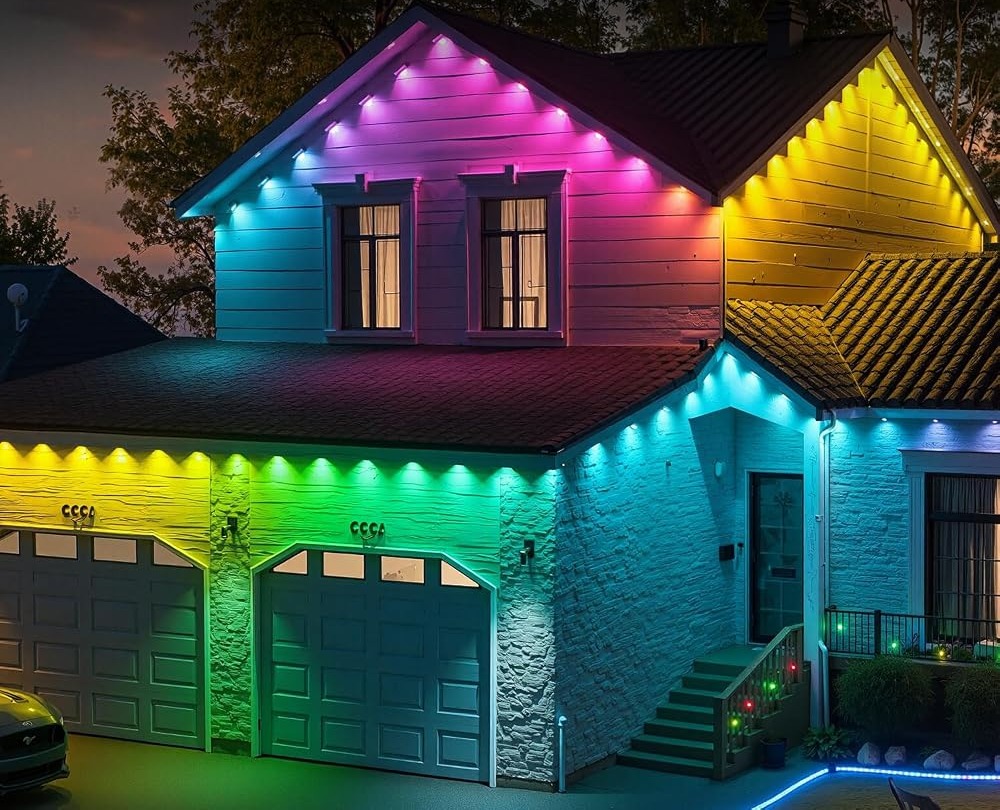
RGBIC adds an individual control channel to each LED. The controller can tell LED number ten to be blue and LED number eleven to be green, then shift those colors a moment later. That is what produces a chase, a gradient or a rainbow that travels along the roofline. The “IC” refers to the integrated circuit that gives each pixel its own address.
In this set, 50 Smart RGB+IC LEDs run along 100 feet, and the seller lists up to 16 million DIY colors. Per-pixel control is also why the 234 dynamic modes and 33 built-in scene modes can look varied rather than repetitive. Without it, most of those modes would collapse into simple flashes.
What Per-Pixel Control Lets You Do
The practical gains show up in the effects you can actually run. With individual-color control, a single strip can do several things a standard RGB strip cannot.
| Effect | Standard RGB | RGBIC control |
|---|---|---|
| Solid color | Yes | Yes |
| Chasing color | Limited to blinking | Smooth travel along the run |
| Two colors at once | No | Yes, on different LEDs |
| Gradient along roofline | No | Yes |
| Music-sync variety | Basic | Per-pixel response |
The table explains why the category matters for eaves. A roofline is long and visible, so a flat single color can look plain. Per-pixel control gives you a way to build a display that changes character through the year.
If you want the wider decision already mapped out, the permanent vs seasonal Christmas lights hub places per-pixel control in context alongside effort and storage.
Where RGBIC Falls Short
Honesty matters here. RGBIC does not mean brighter, and it does not fix a bad install. A run held by adhesive on dusty siding will sag regardless of how many colors it can show. Per-pixel control adds complexity, so it pays off most when you actually use the app to change scenes.
There is also the power question. This is a wired 24V system with an adapter that needs a nearby outlet, not a battery decoration. Another limit is that the long mode list only helps if you rotate scenes; most homes settle on a handful of favorites and leave them there. The app controlled vs timer lights guide explains how much control you gain from the app and whether a simple timer is enough for your habits. If you only ever want one steady color, standard RGB is simpler and per-pixel control is wasted.
How It Affects the Rest of the Buy
Per-pixel control pairs with the other decisions in this cluster. Choosing a wired set means thinking about the outlet, and choosing an app-driven set means deciding how much customization you want. The battery vs hardwired outdoor lights comparison sets the power trade-off, while the LED vs incandescent outdoor lights guide explains why LED suits a long permanent run in the first place.
The seller rates the strip IP67 and says the control box and adapter are rainproof. Treat that as a seller-stated rating, and shelter the box and adapter from direct water. The 50,000-hour figure is a listing estimate, not a guarantee.
What to check before you buy
This set suits someone who wants chasing effects and color variety on a long roofline. Skip per-pixel control if you only want a steady single color and no app.
- Confirm an outlet is near the eaves for the 24V adapter.
- Check that you will use more than one color at a time.
- Plan a sheltered spot for the control box and adapter.
- Treat IP67 as the seller’s stated rating.
- Treat 50,000 hours as an estimate, not a promise.
FAQ
Is RGBIC the same as 16 million colors?
No. Sixteen million colors is the range of shades available; RGBIC is how those shades are placed. Per-pixel control lets different LEDs show different shades at once, which is the part that creates chasing effects.
Can an RGBIC strip show a plain white?
Yes. You can set the whole run to a single tone through the app. The extra control is there when you want it, not forced on every display.
Do I need the app to use per-pixel modes?
A remote is included for basic control, but building custom sequences and scenes is done in the LotusLamp X app. If you only use the remote, you will not get the full benefit.
RGB vs RGBIC lights is a real distinction, not marketing noise, and it decides whether chasing effects look smooth or stubby. If you want the per-pixel version on a full 100ft run, view the RGB+IC eave lights on Amazon.
Views: 0