As an Amazon Associate I earn from qualifying purchases. Links below are affiliate links, which means I may earn a commission at no extra cost to you.
A garland on its own looks like a green rope pinned to a frame. Lights on their own can look thin, three bright shapes with nothing holding the window together. Put them together in the wrong order and you get a tangled mess with a cord in it. The window garland vs window lights question is really a question about sequence and weight: what goes on first, what hangs from what, and how much a frame will take before it complains.
Quick answer
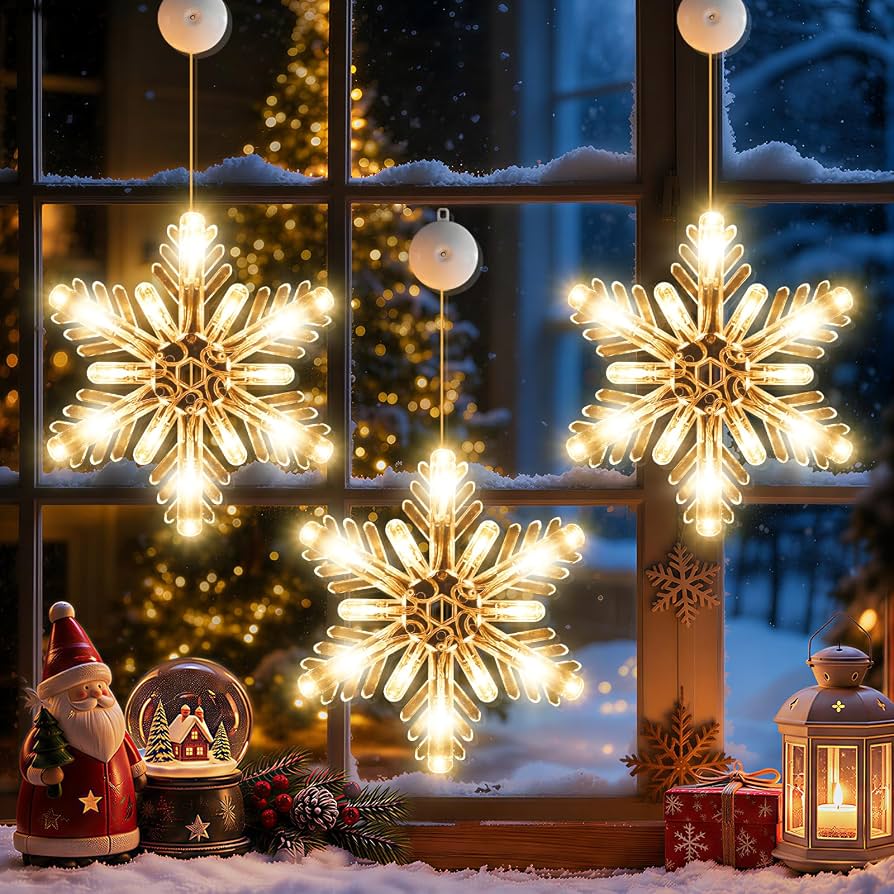
Garland first, on the frame or a rated tension rod. Lights second, on the glass. Ornaments last, on the garland. Garland adds texture and hides the fixing points; lights add the glow that makes the texture readable after dark. A battery-powered piece on the glass keeps the cord count at zero. See the three-piece set on Amazon for that layer.
Window Garland vs Window Lights: What Each One Contributes
Garland is texture and volume. It fills the perimeter of a window with something soft and irregular, and it does a job no light can do: it hides the hardware. Clips, hooks, and the ends of a light string disappear into evergreen.
Lights are the glow. They give the window a reason to be looked at from outside, and they pick up the shape of the garland without illuminating it evenly. Points of light against needles read as depth.
Neither is complete. Garland with no light goes flat at dusk. Lights with no garland float. Layered, each one covers the other’s weakness, which is why the pairing shows up on so many old houses at Christmas.
The layering order, and why it matters
Work from the outside in and from heavy to light.
- Clean the glass and the frame. Garland sheds, and needles on a greasy pane make suction cups fail later.
- Hang the garland. Frame, tension rod, or over-the-door bracket. Get the swag and the corners right before anything is in front of it.
- Mount the lights on the glass. Now, not earlier, because you will move the garland while adjusting it.
- Add ornaments last. Ribbon, berries, small picks. Anything you hang on the garland pulls it down slightly, so it goes on after the shape is settled.
Doing it in this order saves a step. Doing it backwards means re-seating every suction cup after the garland shifts an inch.
How much weight a window frame will take
A nine-foot garland with lights and ornaments is a few pounds, and a few pounds hung from the wrong point is how frames get bent and rods fall.
- Never hang garland from a suction cup. Cups are rated for small light pieces. A garland will pull one off in an hour.
- Use a tension rod rated for the load, with rubber ends, seated between the jambs rather than against the glass.
- Keep load off the sash. The lock, the hinges, and the top rail of a double-hung are moving parts, not anchors.
- Spread the weight. Two or three ties along the top rail beat one loop in the middle.
Check the rod by hanging the garland and tugging gently before you add lights. If the rod bows, it is overloaded.
Fire safety basics
LEDs run cool, which removes most of the heat from the equation, but the setup still has rules.
Keep garland clear of candles, space heaters, and radiator vents. Do not pinch a cord in a window sash or run one under a rug. Use a cord with a fuse in the plug, plug the whole display into one outlet rather than daisy-chaining strips, and switch it off before bed unless a timer is doing it for you. If a garland is real evergreen, it dries out indoors; a dry garland near a heat source is the one combination to avoid entirely.
A battery set on the glass has no cord at all, which removes the sash-pinch problem. The timer handles the switching: six hours on, eighteen off, from the moment you switch it on.
Side by side
| Attribute | Window garland | Window lights |
|---|---|---|
| Adds | Texture, volume, coverage | Glow, silhouette |
| Weight | A few pounds, needs a frame fixing | Ounces, a cup holds it |
| Power | None, unless pre-lit | Battery or cord |
| Covers hardware | Yes | No |
| Fails when | Overloaded rod, dry needles | Dirty glass, cold pane |
| Best position | Frame perimeter | Glass, upper third |
Who should skip the garland
Skip it on a small window. Garland eats the perimeter, and on a 24-inch-wide pane there is nothing left but greens.
Skip it if you dislike shedding. Real evergreen drops needles for the whole season, and even good faux garland sheds a little on the sill. Skip it if you have a cat that treats hanging greenery as a toy, or a radiator directly under the window.
Keep the lights either way. A garland is optional texture; a lit window is the part people notice. For more on coverage, the curtain lights versus window lights comparison covers the wide-window case, and the window lights versus window clings comparison covers the apartment option.
What to check before you buy
- Indoor use. The snowflake set is for interior glass, not the porch or the exterior sash.
- Batteries. Three AAA per piece, not included, so nine cells for three pieces.
- Glass condition. Clean, smooth, room temperature. Grease and cold defeat a cup.
- Timer. Six on, eighteen off, counted from switch-on.
- Color. Fixed warm white, which is what you want next to most garland lights.
If you are weighing a made-up garland against one from a store, the DIY versus store-bought breakdown counts the hours honestly, and the complete buying guide covers power and mounting in order.
FAQ
Should the garland go inside or outside the window?
Inside, in almost every case. Outside means weather, ladders, and anchors you may not be allowed to install. Interior garland also sits where the light can catch it.
Can I put lights on the garland instead of the glass?
Yes, and it looks good, but the glow stays at the edge of the window. Lights on the glass read from the street; lights in the garland read up close.
How do I keep garland from scratching the frame?
Line the contact points with felt pads or a strip of ribbon. Metal hooks on painted trim leave marks that show in daylight even after the garland comes down.
Bottom line
Garland around the frame, lights on the glass, ornaments last. That order solves the weight problem, the cord problem, and most of the visual mess in one pass. The garland does the texture, the lights do the glow, and neither has to carry the whole window. View the warm-white set on Amazon to finish the layer that actually shows at night.
Views: 0