As an Amazon Associate I earn from qualifying purchases. Links below are affiliate links, which means I may earn a commission at no extra cost to you.
On January 2 the window looks wrong and nobody can say exactly why. The tree is at the curb, the cards are down, and a row of reindeer is still taped to the glass, three weeks past their expiration date. Winter window decorations solve that gap: a small set of pieces that read as the season rather than the holiday, so the window stays dressed until the light comes back. The trick is deciding, in advance, which pieces belong to December and which belong to the whole winter.
Quick answer
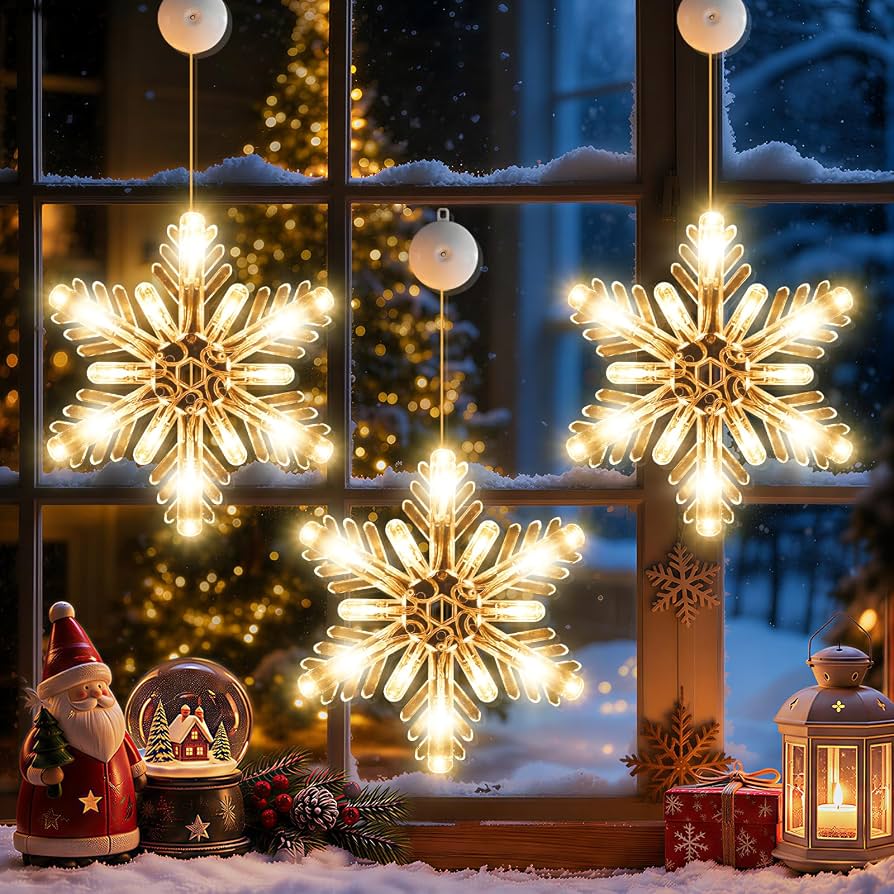
Keep anything that reads as weather rather than event: snowflakes, bare branches, evergreens, warm white light. Pack anything with a face, a date, or a red-and-green color scheme. A three-piece snowflake set is close to ideal for January because the silhouette is seasonal and the warm white does not shout December. Check the current price on Amazon if you want a set that earns its place for two months.
Winter Window Decorations: The Test That Decides What Stays
Ask one question of every object on the sill: would this look right in a store window on February 10? If yes, it stays. If the answer depends on a specific date — December 25, New Year’s Eve — it goes in the box.
That test sorts a typical window in about ninety seconds:
- Stays: snowflakes, plain evergreen garland, birch branches, pinecones, white lights, silver or glass ornaments with no lettering.
- Goes: Santa, reindeer, elves, gifts, “Merry Christmas” lettering, red-and-green ribbon, anything with a countdown.
The trap is the middle category — a red bow, a plaid ribbon, a nutcracker. Each is defensible in January and none of them helps. When in doubt, take it down; an edited window always looks more deliberate than a full one.
Why snowflakes and warm white survive the calendar
A snowflake has no date on it. It appears in November, it is still true in February, and it does not belong to one holiday. That is why it works as the backbone of a winter window rather than an accent.
Warm white matters for the same reason. Cool white reads as icicle and storefront; warm white reads as lamp light, which is what a house looks like in a cold month. A single warm tone across three pieces also solves the amateur problem, which is five competing colors in one pane.
The practical bonus is that a battery-powered piece does not care what month it is. No timer reset, no outdoor circuit, no extension cord snaking behind the curtain. The set runs six hours on and eighteen off until you switch it off for the season, which means a January window asks nothing of you but a fresh set of cells.
The January swap, in 20 minutes
Do it on the first weekend after New Year, while the box is still out and the ladder is still in the hall.
- Clear the pane completely. Everything off the glass, including the tape residue.
- Wipe the glass. Warm water, a drop of dish soap, dry fully. Cups need a clean surface.
- Sort into three piles. Keep, store, donate.
- Put the snowflakes back on. Same height, even spacing, upper third of the pane.
- Set the timer at dusk. Six hours on from that moment, then eighteen off.
The look you are after is sparser than December. Three pieces on a wide window, two on a narrow one, and nothing else on the glass. If you want more, add a single unlit element — a branch, a pinecone on the sill — rather than a second light set.

What comes down on December 26
| Piece | Keep or store | Why |
|---|---|---|
| Snowflake window lights | Keep | Weather, not holiday |
| Evergreen garland, unlit | Keep | Reads as winter |
| Santa, reindeer, elves | Store | Dated character |
| Red-and-green ribbon | Store | Color says December |
| Lettered signs and banners | Store | Text fixes a date |
| Tinsel and metallic sprays | Store | Reads as party, not season |
Store the Christmas-only pieces in one labeled box, not scattered through the attic. Next year you will want them in a single place, and the six-week Christmas decorating timeline assumes you can find them in week one.
Where the pieces go once the tree is gone
The tree is the anchor of a December room, and taking it out leaves a hole. Window lights are the simplest way to re-anchor a room, because they work from outside and from the couch.
Three placements that hold up in January:
- Front window, three across. The classic. Reads from the street all winter.
- Kitchen window, two stacked. A small pane over a sink takes two pieces and looks intentional.
- Bedroom or hallway mirror. The battery door stays reachable, and the glow lands on a wall instead of a street.
If your windows are high or sealed, the guide to when to put up Christmas lights covers the install order, and if you plan to run the display into February, the lights after Christmas guide sets the end date.
What to check before you buy
- Indoor only. These are interior-window pieces, not porch decor.
- Nine AAA cells, not included. Three per piece, bought separately.
- Fixed warm white. No color change and no cool-white setting.
- Three pieces. Enough for one large window or two small ones, not a whole house.
- Clean smooth glass. Textured or dirty panes will not hold a cup.
Skip this set if you want a color-changing display, an exterior window, or something that carries into March. By late February even a snowflake starts to feel like a holdover, and the twenty-question FAQ covers when most people pack up.
FAQ
Can snowflake lights stay up in January?
Yes. A snowflake is a winter shape, not a Christmas one, and warm white light reads as seasonal through February. Take down anything with a character, a greeting, or a red-and-green scheme.
What do I do with the window between Christmas and New Year?
Leave the snowflakes and remove the character pieces. That week is the transition, and a mostly-winter window with one or two holiday accents still looks intentional.
How many pieces does one window need?
Two for a narrow pane, three for a standard double-hung, and two sets for a wide bay. Odd numbers and even spacing read best from the street.
Bottom line
The January window is a subtraction problem, not a shopping problem. Pull the dated pieces, keep the snowflakes, wipe the glass, and set the timer once. Three warm-white pieces on a clean pane will carry a room from New Year to the end of February without a single change. See the three-piece set on Amazon if your current window has nothing left after the edit.
Views: 0