As an Amazon Associate I earn from qualifying purchases. Links below are affiliate links, which means I may earn a commission at no extra cost to you.
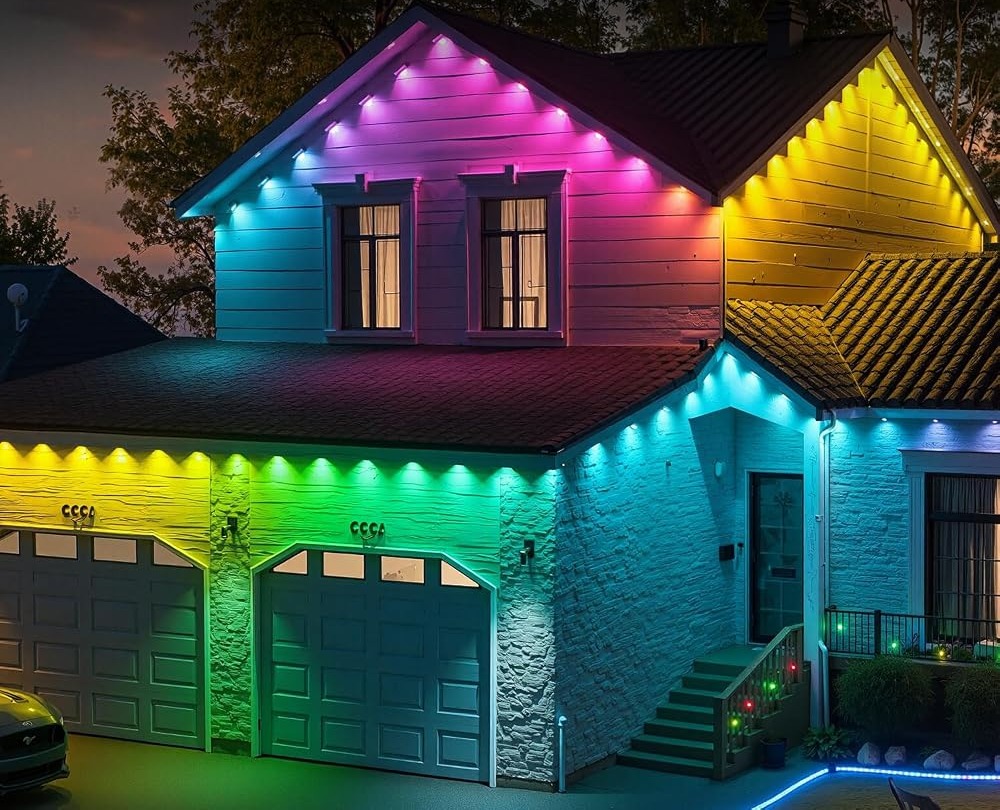
16 million colors outdoor lights is a phrase that sounds like pure marketing until you consider what it changes on a house. A color count tells you how finely you can tune a shade, not how bright the strip is or how many effects it can run. On a 100ft eave run with 50 individually controlled LEDs, that depth shows up as gradients and tones that sit close to your siding instead of fighting it. This guide turns the number into everyday choices: when extra color depth earns its place, when a plain white looks cleaner, and how to pair depth with per-pixel control.
Quick answer
16 million colors outdoor lights means the controller can mix a huge range of shades for each pixel, well beyond a short list of preset hues. In daily use you will reach for it to dial in soft ambers, muted blues and tones that match trim, not to cycle through every possible value. Combined with per-pixel control, it lets color shift gradually along the whole run. Check the current price on Amazon.
What 16 million colors outdoor lights actually gives you
Think of the number as resolution for hue. A cheap light might offer eight or twelve fixed colors, so every house with it looks the same. A palette of up to 16 million DIY colors lets you nudge a shade toward warm or cool until it suits the surface behind it. That is the real benefit: subtle control rather than novelty.
It helps to be honest about what the figure does not mean. It is not a brightness figure, and a deeper palette will not make the strip throw more light onto the driveway. It also does not mean you will consciously pick from millions of options. Most people settle on five or six shades they like and return to those. The value is that those six can be exactly right instead of approximately right, which matters on a long, highly visible front elevation.
Why per-pixel control matters more than the count
Color depth only pays off when individual LEDs can show different shades at the same time. That is what the IC part of RGB+IC provides on this 100ft set: each of the 50 LEDs is addressable. A deep palette combined with one controller for the whole strip would still only give you one color at a time. With per-pixel control, the depth becomes motion, because neighboring pixels can hold nearby shades and let a tone travel. That is the basis of the chasing light effects explained in this guide, and it is why a gradient looks smooth here but blocky on a basic strip.
The practical takeaway is to judge a set on both numbers together. A large color count with no individual control is less useful than a moderate count with it.
Subtle shades versus the rainbow default
Here is how the same color depth plays out in three common situations:
| Situation | Better choice | Why |
|---|---|---|
| Front roofline seen from the street | One tuned shade or a slow two-tone | Reads as intentional, not busy |
| Porch or entry at dinner time | Warm amber at lower brightness | Welcoming without glare |
| Party or holiday evening | Faster multi-color mode | A lively display is the point |
The rainbow cycle is the default many people first try, and it gets old quickly on a permanent installation. Because this set is meant to stay up all year, the shades you choose will be seen for months, so it is worth dialing them in once. If you want a structured way to narrow the options, making sense of the dynamic modes covers building a shortlist you will actually use.

Getting the look you want from the app
The LotusLamp X app is where color depth becomes usable. It lets you customize color, brightness, speed and sequence, and it includes a timer for scheduled lighting. For a subtle look, start by dropping brightness well below maximum, then choose a shade close to your trim color and let a slow sequence carry it along the eave. The included remote covers basic changes when a phone is not handy.
Color depth also interacts with the 33 built-in scene modes. Those presets are a quick way to see how a palette looks before you build your own, and the scene modes for lights, grouped by mood explains how to pick one that suits a front exterior without looking cluttered.
What to check before you buy
Deep color palettes reward buyers who will spend a few minutes tuning settings once.
- Confirm per-pixel control, not just color changing, if gradients matter.
- Check the pixel count and spacing for your mounting height.
- Plan a sheltered spot for the rainproof control box and adapter.
- Make sure an outlet sits near the start of the run.
- Treat IP67 as the seller’s stated rating and keep the adapter out of direct water.
- Read the up-to-50,000-hour life figure as a listing estimate, not a promise.
FAQ
Does more colors mean a brighter light?
No. The color count describes how finely shades can be mixed, not output. Brightness is adjusted separately in the app. A strip with a large palette can still be dimmed to a soft glow, which is often the better look on a facade at night.
Will I actually use millions of colors?
Unlikely, and that is fine. The practical benefit is precision: the few shades you do choose can be tuned to match siding, brick or trim. Most owners keep a small set of favorites and reuse them across seasons rather than exploring every value.
Is a deep palette worth it for a front door only?
Less so. The advantage shows on a long run where color can travel or graduate. On a short segment, one well-chosen warm white often looks cleaner. If your display is small, prioritize brightness control and a good preset over raw color count.
XINKAITE’s 100ft RGB+IC set pairs up to 16 million colors with per-pixel control, which is what makes those subtle shifts possible along a full eave. If a tunable, year-round display suits your home, see the RGB+IC eave lights on Amazon to review the current set.
Views: 0