Place one block and watch three lines disappear at once — that is a combo, and it is one of the most satisfying moments in Neon Block Blast. A combo happens when a single placement clears more than one line, or when a chain of clears follows from one well-chosen move. This guide explains how combos form, why they matter for your score, and how to set them up on the 8×8 grid.
New to the game? this guide explains what Neon Block Blast is and how the basics work before you dive into combos.
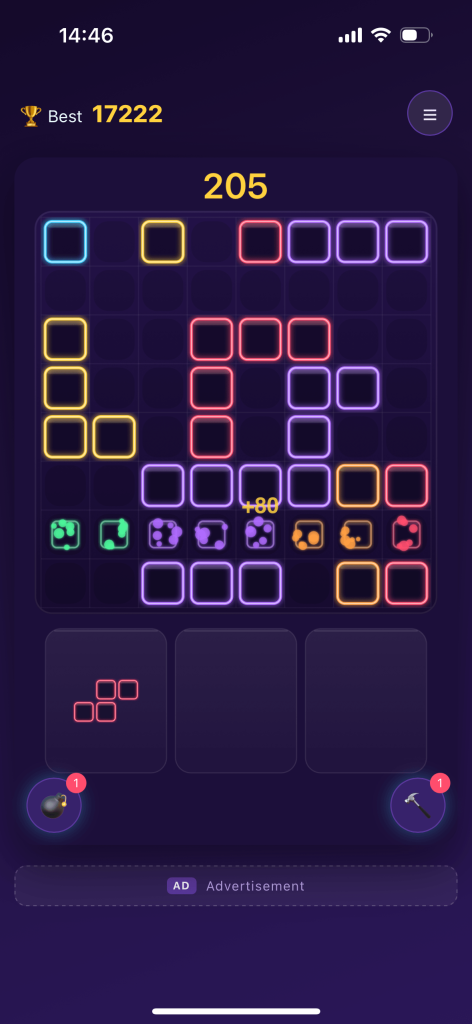
What counts as a combo
In the simplest terms, a combo is a multi-line clear. On the 8×8 grid, you fill a row or a column and it clears. Sometimes one placement completes several lines at the same time — a row and a column, two rows, or even more. That single move that clears multiple lines is a combo, and it is rewarded more than clearing lines one at a time.
The reason combos feel special is that they are efficient. Instead of spending several moves to clear several lines, you do it in one. That frees up space quickly and keeps the board playable for longer.
How a placement clears multiple lines
Every block you place occupies several cells. If those cells complete more than one line simultaneously, all of those lines clear together. For example, an L-shaped piece might finish a vertical column and a horizontal row at the same time. Both disappear, and you get the combined reward.
This is why the shape of the piece matters as much as where you put it. In Neon Block Blast, pieces keep a fixed orientation — you cannot rotate them (this guide explains why). So a combo depends on finding the spot where a fixed shape happens to complete several near-full lines at once.
The skill is in preparation. You do not make a combo at the moment you place the piece; you make it over the previous several moves, by bringing two or three lines close to full at the same time.
Why combos matter for scoring
Combos are rewarded more generously than single clears. Clearing two lines with one placement earns more than clearing the same two lines in two separate moves. That means a player who plans multi-line clears will generally score higher than one who clears lines as soon as each one is ready.
This creates an interesting decision. When a row is almost full, you can clear it immediately with a small piece — or you can hold off, keep building a second and third line, and clear them all together for a bigger reward. The second option is riskier, because it leaves more lines hanging, but the payoff is larger.
Learning when to take that risk is part of getting better at the game. If your board has plenty of space, waiting to build a combo is often worth it. If the board is tight, taking the safe single clear may be smarter.
Setting up a combo step by step
Here is the basic pattern for building a combo:
- Pick two or three lines to target. Choose rows or columns that share cells and are not yet full.
- Fill them in parallel. Place blocks so several lines get close to complete at the same time, rather than finishing one first.
- Watch the gaps. Track which empty cells remain in your target lines. The ideal final piece is one whose shape fits those gaps.
- Place the finishing piece. When a single block will complete multiple lines, drop it there and collect the combo.
- Enjoy the open board. Multiple lines clearing at once frees a large area, giving you room for the next several moves.
This pattern is the foundation of high-score play. this guide collects ten broader tips that complement this approach.
Using boosters to trigger combos
The two boosters can help you build combos. The Hammer removes a single block, which can complete a line instantly. The Bomb clears a 3×3 area, which can reshape a region so that several lines become near-complete. Used as setup rather than rescue, both boosters can lead directly into a multi-line clear. this guide explains when to use the Bomb and the Hammer.
A useful trick: use a booster when a couple of lines are already close to full. The booster removes the obstacle, and the next placement finishes the job as a combo.
Combos without a timer
One thing that makes combos especially enjoyable in Neon Block Blast is the absence of a timer. Because nothing is counting down, you have all the time you need to scan the board, identify a potential combo and set it up. Combos here are an act of planning, not reflex. this guide explains why the game was designed without a timer and how that changes the way you play.
That calm pace is a big part of the appeal. You can study the grid for as long as you like, then make a deliberate move that clears several lines at once.
Combos in both modes
Combos work the same way in Classic mode and Adventure mode. In Classic mode, they are a path to higher scores on the open-ended grid. In Adventure mode, they help you clear levels efficiently and deal with obstacles. this guide covers Classic mode in full, while this guide explains Adventure mode.
Either way, the principle is identical: bring several lines close to full, then finish them together.
Start small, then aim bigger
If you are new to combos, do not try to clear four lines at once on your first attempt. Start by noticing when a single placement can clear two lines instead of one. Once that becomes natural, begin holding off on easy clears in order to set up two or three at the same time.
Every combo you build teaches you something about how the shapes and the grid interact. Over time, spotting a combo setup becomes second nature — and that is when the game really opens up.
The game is free to play, with an optional one-time in-app purchase to remove ads. It works offline, saves progress automatically, and runs on Android 7.0 and later.
Download Neon Block Blast on Google Play and start building combos:
https://play.google.com/store/apps/details?id=com.jinjie.neonblast

For answers to common questions about combos, modes and rules, see this guide.
Views: 0