Most people discover Neon Block Blast through Classic mode. It is the mode the game opens with, the mode that teaches you the rules in about thirty seconds, and the mode that fits a two-minute wait better than almost anything else on a phone. An endless 8×8 board, a tray of shapes, no timer, and a high score that belongs only to you.
Then there is Adventure mode, and a lot of players treat it as a slightly harder version of the same thing. That is not quite right. Adventure changes the question you are answering. Classic asks how long you can keep a board alive. Adventure hands you a specific board with a specific problem already built into it and asks you to solve that problem. The rules of placement do not change, but the way you think about space, sequence and risk changes completely.
This guide is about that second kind of thinking. It covers what Adventure mode contains, how the ice, wood and stone obstacles differ, how the Bomb and Hammer boosters behave, and a repeatable approach to a level you have never seen before. It also covers the small practical things people ask about most: whether progress is saved, whether you can play without a connection, and which mode to open depending on how much time you have.
If you are new to the game entirely, start with our Neon Block Blast review, which walks through the rules from zero. If you already know the rules and want to raise your scores in endless play, the ten block puzzle tips for higher scores are the better read. This article sits between the two: it assumes you can place a block, and focuses on what happens once the board starts pushing back.
What Adventure Mode Actually Is
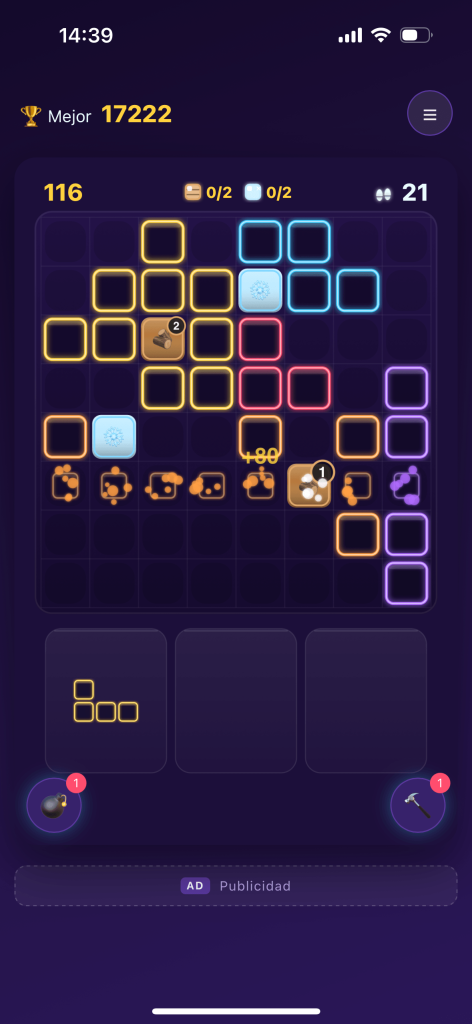
Neon Block Blast splits its content into two modes: Classic and Adventure. Classic is endless. There are no levels, no targets and no finish line; you play until none of the shapes in the tray can fit, then start again and try to beat your own best. Adventure is structured. It offers more than 40 handcrafted levels built around ice, wood and stone obstacles that you need to break through.
That single difference, structured levels instead of an open-ended run, has a surprisingly large effect on how a session feels. In Classic, every board starts empty and every mistake is self-inflicted. In Adventure, the board arrives with a situation already in progress. Some cells are occupied by obstacles rather than by blocks you placed. The space you have to work with is decided for you. Your job is to read that starting position and find the sequence of clears that opens it up.
The exact objective of each level is shown in the game itself, and the layouts vary as you move through them. This guide deliberately does not invent level numbers, move limits or star ratings. What it does instead is describe the thinking that stays useful across all of them: how to read an obstacle layout, when to clear early, when to hold a line for a bigger combo, and when a booster is worth spending.
A useful way to frame it: Classic is a test of endurance, Adventure is a test of planning. Both use the same vocabulary, but they are not the same conversation.
The Rules Stay the Same, and That Matters
The nice thing about Adventure is that you do not have to relearn the game. Every rule you learned in Classic still applies.
You are given a selection of shaped blocks in a tray below an 8×8 grid. You drag a block onto the board, and once placed it stays there until a line clears it. When every cell in any horizontal row or vertical column is occupied, that line disappears and frees up the space. Clearing two or more lines with one placement produces a combo, which is worth more than clearing the same lines separately. Blocks cannot be rotated, so the orientation you are given is the orientation you must work with. There is no timer. In endless play, a run ends when no available shape fits anywhere on the board.
Those constraints are what make the mode interesting, because the obstacles do not replace the rules, they interact with them. A blocked cell is not just one less empty square. It changes which rows and columns can realistically be completed, which shapes can be placed nearby, and where a combo can be set up. An ice tile sitting in the middle of a promising row does not simply cost you a cell; it can make a four-cell gap useless for a shape that would otherwise fit perfectly.
This is also why the no-timer design decision matters more in Adventure than anywhere else. When a board is constrained from the start, the correct move is often not obvious. Being able to sit and read the layout for as long as you need is not a small comfort here, it is the core of the experience.
The Three Obstacle Types: Ice, Wood and Stone
Adventure introduces obstacles made of three materials: ice, wood and stone. They give the mode its difficulty curve and its visual identity, and they are the main reason a level can feel completely different from the one before it.
Ice
Ice is the material most players meet first. Visually it reads as fragile, and that is a useful mental model: it is the obstacle that gives way most readily when you clear lines around it. Early levels use ice to teach the basic relationship between clearing and obstacles. You complete a row, the ice in that row breaks, and the board opens up. The lesson is simple and it lands quickly: clearing lines is not only about score, it is how you remove things that are in your way.
Wood
Wood is sturdier. It takes more deliberate work to shift, which means you cannot rely on a single convenient clear to open a wood-heavy region. Wood tends to reward sequencing. Rather than taking the first line available, you look at which clears will expose the wood, then set up the placement that finishes the job. This is where players who came straight from Classic often stall, because the instinct there is to take every safe clear immediately.
Stone
Stone is the most resistant of the three. A stone-heavy layout is a space-management puzzle in the strict sense: you have fewer usable cells, fewer viable rows, and less room to park awkward shapes while you wait for the piece you need. Stone is where boosters earn their keep, and where holding a combo for one more move can be either clever or fatal. The boards that feel hardest are usually not the ones with the most obstacles, but the ones where the obstacles sit in positions that split the grid into small, disconnected pockets.
Across all three, the practical habit is the same: before placing anything, identify which rows and columns are already close to complete, and note where the obstacles sit inside them. A nearly full row with one ice tile is an opportunity. A nearly full row with a stone tile in the middle and no shape that fits the remaining gap is a trap you should not build around.
How Levels Change the Way You Think
In Classic, the optimal habit is often to keep the board as empty as possible. Every clear is a small refund of space, and space is the resource that keeps a run alive. In Adventure, that habit still helps, but it competes with a second priority: breaking through the obstacle layout.
Sometimes the correct move is an immediate clear that gives you almost no points but removes an obstacle and reconnects two halves of the board. Sometimes it is worth leaving a row one cell short for two or three placements so that a single piece can complete a row and a column together, producing a combo and breaking obstacles in both directions at once. Classic rarely asks you to delay a clear. Adventure asks constantly.
There is also a psychological difference. In an endless run, a bad board is a temporary problem; you will start another run in a minute. In a level, a bad board is the problem you came to solve. That makes it worth pausing before the first placement. Read the tray, read the obstacle positions, and decide which region of the grid you want to open first. The first two placements in a level usually determine whether the remaining ones are comfortable.
If you want a broader set of habits for reading an 8×8 board, the block puzzle tips guide covers things like protecting the centre, planning for the whole tray rather than one piece at a time, and recognising when a run is already lost. Those habits transfer directly into Adventure; the difference is that here you apply them to a board you did not get to choose.
Power-Ups in Adventure: Bomb and Hammer
Neon Block Blast gives you two boosters, and both are more valuable in a constrained level than they are in an open endless board.
Bomb
The Bomb clears a 3×3 area. It is an area tool, which makes it the right answer when a cluster of blocks and obstacles has formed in one region and no shape in the tray fits around it. In Adventure, a well-placed Bomb can reconnect two pockets of the grid and turn an unplayable board into a manageable one. Because it covers nine cells, its value rises when the obstacles you need to break are close together, and falls when they are scattered across the board.
Hammer
The Hammer smashes a single block. It is a precision tool rather than a rescue tool. The classic use is removing the one stubborn cell that is stopping a row from completing, or carving out a gap that exactly matches an awkward shape in the tray. In a level with one remaining obstacle in an otherwise clear line, the Hammer is often the cheapest possible solution. It does very little when the problem is general crowding, and a great deal when the problem is one specific square.
When to Spend Them
You earn boosters by clearing lines, so the better you play the more options you build up. That creates a decision point worth taking seriously. Spending a Bomb on a mildly awkward board wastes a resource you may need three moves later. Hoarding both boosters until the grid is completely jammed can be just as costly, because by then there may be no placement that sets up a clear at all.
A reasonable rule of thumb: use the Hammer the moment a single cell is clearly the bottleneck, and save the Bomb for the moment when two or more regions of the board have stopped communicating with each other. In both cases, spend to restore your ability to place shapes, not to chase points. Boosters are space tools first.
A Practical Order of Play for a New Level
When a level opens and you have never seen it before, a short routine beats improvisation.
- Read the obstacles before the tray. Find the ice, wood and stone clusters and note which rows and columns they sit in.
- Identify the nearly complete lines. A row that is one or two cells from clearing is your most reliable lever, especially if the missing cells are reachable.
- Check the tray against those gaps. Because blocks cannot be rotated, a tempting three-cell gap is only real if one of the available shapes matches its orientation.
- Decide which region to open first. Prefer the region that connects to the most empty space, not the one that looks easiest.
- Place for the second move, not just the first. Ask what the tray will probably offer next and whether your current placement leaves a usable gap.
- Clear to break obstacles, not only to score. A low-value clear that removes wood or stone is usually worth more than a slightly better combo that leaves the layout untouched.
- Hold a combo only when the board can survive the wait. A delayed multi-line clear is powerful, but not if it leaves you with no legal placement on the next turn.
- Spend a booster when space, not score, runs out. That is the moment a Bomb or Hammer changes the outcome.
- If the level is lost, restart early. There is no timer and no penalty for trying again. Reading the opening board more carefully on the second attempt is faster than fighting a dead grid.
That last point is easy to overlook. Because Adventure is level-based rather than endless, a fresh start is cheap. Players who treat a stuck board as a puzzle to be solved by brute force tend to burn boosters they did not need to spend.
Common Reasons Players Get Stuck
| What the board looks like | What usually caused it | What to try next |
|---|---|---|
| Several small empty pockets, none larger than two cells | Placing pieces wherever they fit instead of protecting open rows | Work back toward one full row or column; use a Bomb to reconnect pockets |
| A nearly complete line that never gets finished | The tray keeps offering shapes in the wrong orientation | Clear a different line to cycle the tray; use a Hammer on the single blocking cell |
| Obstacles remain in one corner while the rest is clear | Clearing only the easy lines and ignoring the obstacle rows | Deliberately build toward the obstacle cluster, even at a lower score |
| The grid jams two moves after a big combo | Holding the combo for too long and parking awkward shapes | Take the earlier single clear; prioritise legal placements over bonus points |
| Boosters run out before the layout opens | Spending a Bomb on mild crowding | Save the Bomb for disconnected regions; use the Hammer for one-cell problems |
Adventure vs Classic: Which Should You Open?
Both modes ship in the same free install, and neither is the “real” game. They are built for different amounts of attention.
| Classic | Adventure | |
|---|---|---|
| Structure | Endless run | More than 40 handcrafted levels |
| Board | Starts empty | Starts with ice, wood and stone obstacles |
| Main question | How long can I survive? | What sequence opens this layout? |
| Best for | Two quiet minutes, high-score chasing | A focused session with a sense of progress |
| Pace | Entirely self-directed | Still untimed, but more deliberate |
| Boosters | Useful rescue tools | Often part of the solution |
| Failure | No shape fits | The level is not solved; restart is cheap |
If you have five minutes and want to switch off, Classic is the better pick. If you have fifteen and want the satisfaction of finishing something, open Adventure. If you are deciding between the two because you are not sure which kind of puzzle player you are, our comparison of block puzzles, match-3 and falling-block games puts the whole family of genres in context.
Offline Play and Progress Saving
One practical reason Adventure works well as a commute game: Neon Block Blast is fully playable offline, and progress is saved on the device automatically. You do not need a connection to open a level, and you do not need an account to keep what you have done. If a train goes into a tunnel mid-level, nothing is lost.
That also means there is no account sync to worry about and no server-side wait between attempts. Restarts are instant, which matters more in a level-based mode than it sounds. The faster you can try a board again with a different opening, the more likely you are to notice the pattern you missed the first time.
The game is free to download and play, contains ads, and offers an optional one-time in-app purchase that removes ads permanently. There is no subscription. If you want the reasoning behind that model, we wrote a whole guide to free puzzle games without subscriptions.
Frequently Asked Questions
How many levels are in Adventure mode? More than 40 handcrafted levels, built around ice, wood and stone obstacles. The exact goal of each level is displayed in the game.
Do the rules change in Adventure? No. You still drag non-rotating blocks onto an 8×8 grid and clear full rows or columns. What changes is the starting board and the presence of obstacles.
Is there a timer in Adventure mode? No. There is no countdown in either mode, so you can read the layout for as long as you like before placing a block.
Can I rotate blocks to fit an obstacle gap? No. Shapes arrive in a fixed orientation, which is why checking the tray against the available gaps is such an important part of solving a level.
What does the Bomb do? It clears a 3×3 area. It is most useful when blocks and obstacles have clustered and cut one part of the grid off from the rest.
What does the Hammer do? It smashes a single block. It is the precise tool for removing one stubborn cell that prevents a line from completing.
Can I play Adventure offline? Yes. The game is playable without a connection and saves progress on the device.
Is Adventure mode free? Yes. Both modes are part of the free game. Ads are included, and a one-time purchase removes them. See the Neon Block Blast FAQ for the full list of common questions.
Which mode should a beginner start with? Classic. It teaches the placement and clearing rules on an empty board, and every habit you build there transfers to Adventure.
Where can I download the game? From the official Google Play listing. See the end of this article.
Where to Start
If you have only played Classic so far, open Adventure and spend the first level doing nothing but reading. Look at where the obstacles sit, which rows are close to complete, and which shapes in the tray actually match the gaps. Then make one placement that opens space rather than one that scores points. That single change of priority is what makes the mode click.
Neon Block Blast is developed and published by Shenzhen Jinjie Network Technology Co., Ltd. It is free on Google Play, works offline, and includes both Classic and Adventure in the same install. For a full walkthrough of the game, modes, boosters and the free-to-play model, read our Neon Block Blast review.
Download Neon Block Blast on Google Play: https://play.google.com/store/apps/details?id=com.jinjie.neonblast
Explore more: relaxing offline puzzle games with no timer and block puzzles and spatial reasoning.
Further reading: games like Block Blast and how to choose an alternative and what defines a Block Blast-style 8×8 puzzle.
Views: 0