As an Amazon Associate I earn from qualifying purchases. Links below are affiliate links, which means I may earn a commission at no extra cost to you.
Yard lighting ideas often stop at the front door, which leaves the rest of the property dark and disconnected. A permanent eave run can do more than trace the entry: with 100 feet of strip and 50 RGB+IC LEDs, it can continue down a side elevation, pick out a gate, or outline a deck, provided there is a surface to mount to. The limit is honest and simple. A fixed strip follows structure; it cannot float across an open lawn the way a post light or draped string can. This guide maps where the run reaches and where a different approach is the smarter choice.
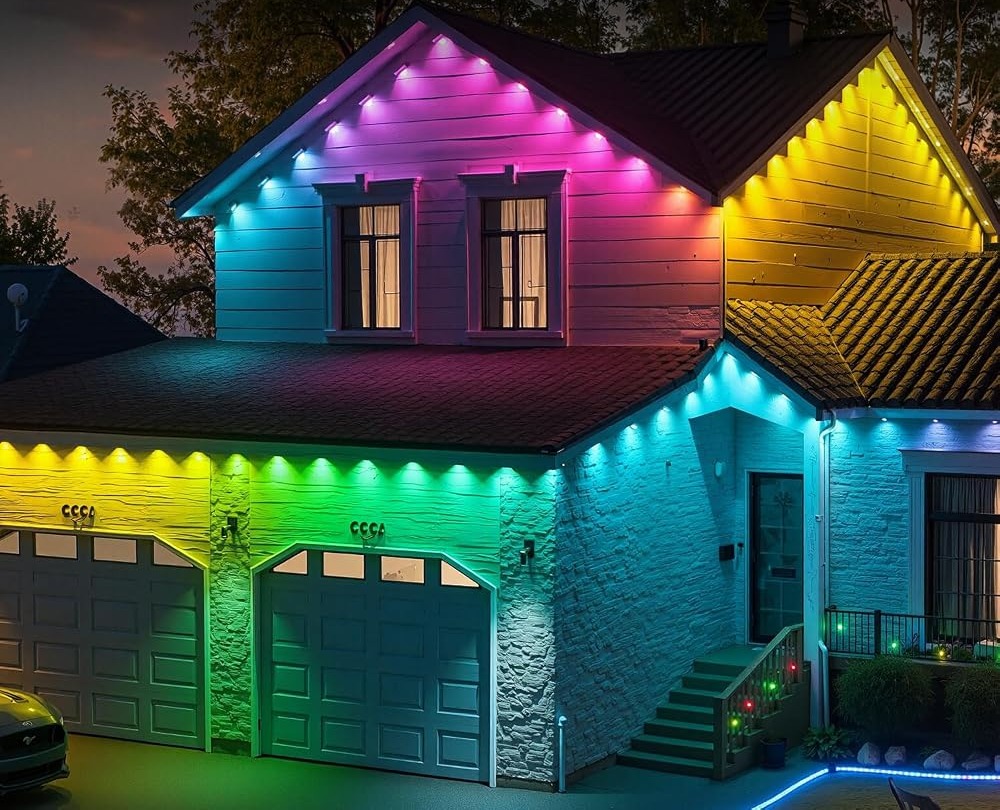
Quick answer
Extend the run from the front along any side elevation or covered walkway that has a fascia to mount to, then stop when the 100 feet run out. Use one consistent accent color so the yard reads as an extension of the house, not a separate display. Check the current price on Amazon.
Yard lighting ideas: start where the structure ends
The most reliable yard zones are the ones attached to the house. A side elevation has a fascia or soffit just like the front, so the same mounting method carries the run around the corner. A covered walkway or a gate with a solid frame gives you another surface to follow. These areas benefit most from a permanent strip because they stay usable after dark and never need re-hanging.
Open ground is different. There is no fascia above a lawn or a garden bed, so a fixed strip has nowhere to go. For those spots, a post-mounted fixture or a draped light is the right category. The hub on eave lights for a house explains the principle: establish the structural outline first, then decide which open areas genuinely need their own solution.
Plan the zones by what the run can reach
Before you buy, sketch the property and mark every surface that could carry the strip. Then compare the total path with the 100 feet available.
| Zone | Mounting surface | Realistic fit |
|---|---|---|
| Front roofline | Fascia | Yes, first priority |
| Side elevation | Fascia or soffit | Often, if length remains |
| Gate or walkway | Solid frame or beam | Sometimes, with a clear path |
| Open lawn or bed | None | No, use another category |
That table makes the boundary clear. A fixed run excels on edges and structure; it is a poor tool for lighting open ground. The 50 pixels spread every two feet along the run, so a long side elevation still reads as a continuous line rather than scattered points.
Side elevations, gates and paths
When the run turns a corner, plan a soft bend and secure the strip on both sides of the turn, as you would on the front roofline. Keep the line at a consistent height so it looks deliberate from the yard. A gate or a covered path works best when the strip follows an existing beam rather than crossing open space between two points.
Brightness matters more out here than color. A modest single tone marks a path without drawing the eye away from the house. For a complete scheme, the guide to front of house lighting with a layered approach shows how the structural run acts as the backbone while other fixtures handle specific tasks. Under a covered walkway, the wash from a strip mounted on the soffit can be enough on its own; the article on soffit lighting ideas for a clean downlight look covers that effect in detail.

Where the 100ft run stops
Accept that one kit cannot circle a large lot. Once the front and one side are lit, the remaining length usually runs out before a rear elevation. That is fine: a clean, partial plan looks better than a stretched one that fades before it reaches a sensible endpoint. Decide the endpoint in advance and let the run terminate at a corner or a natural break.
A deck is a common next zone because it is a structure with edges. The guide to deck lighting ideas with color-changing LEDs explains how to add color to a deck frame while keeping brightness comfortable for evening use. If a zone has no structure at all, treat it as a separate project rather than forcing the eave set to do a job it was not built for. That is the honest drawback of a fixed run, and planning around it saves frustration.
What to check before you buy
A yard plan works best when it follows real surfaces. This set suits a property with continuous fascia or beams; it is weaker if the interesting areas are all open ground with no mounting point.
- Sketch every structure that could carry the strip.
- Measure the total path and compare it with 100 feet.
- Plan soft bends at each corner and allow slack.
- Keep the rainproof control box near an outlet and under cover.
- Use one consistent color so the yard extends the house.
- Treat the IP67 strip rating as seller-stated and the 50,000-hour life as an estimate.
FAQ
Can the run cross an open yard between two buildings?
Not as a fixed strip, because there is no surface to mount to. A fixed run follows structure. For a gap across open ground, use a post-mounted fixture or a draped light instead, and keep the permanent strip for the edges.
Will one set light the front and the whole yard?
Rarely on a large lot. One 100ft run usually covers the front and part of a side. Prioritize the most visible edges, end the run at a natural corner, and treat distant zones as separate projects.
How do I keep a long side run from looking cluttered?
Use a single soft color at moderate brightness and keep the mounting height consistent. The 50 per-pixel LEDs can create effects, but a calm line reads as part of the house rather than a string of decorations.
A yard plan succeeds when it follows the structure: outline the front, continue along any side that has a surface, and stop cleanly when the length runs out. This 100ft RGB+IC set gives you the reach and app control to make those zones consistent. If that matches your property, see the current listing on Amazon.
Views: 0