The 8×8 block puzzle is one of the simplest games to learn and one of the hardest to master. The rules fit into a single sentence — place shapes on a grid, complete rows or columns to clear them, and keep going as long as you can — but the details are what make each round interesting. This guide walks through the 8×8 block puzzle rules step by step.
New to the game? this guide introduces Neon Block Blast in full before you dig into the rules here.
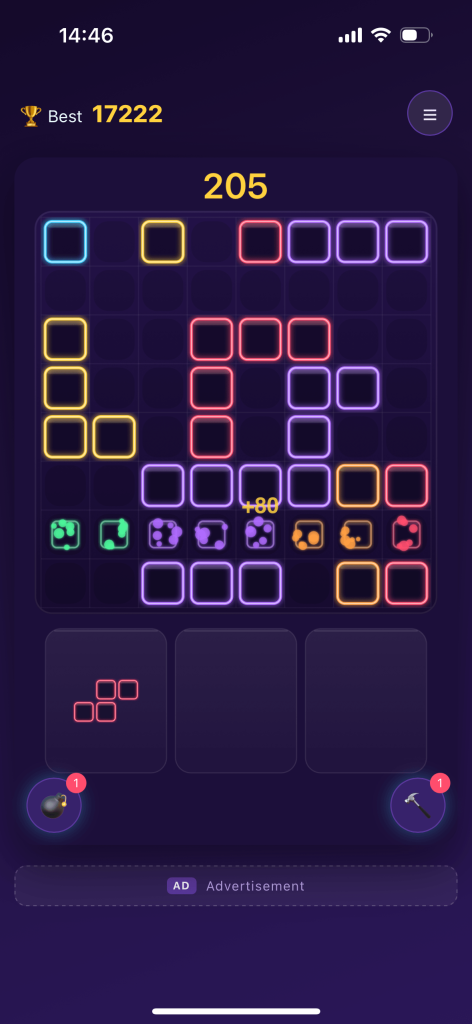
The grid and the pieces
The playing field is an 8 by 8 grid: eight rows and eight columns, for 64 spaces in total. Pieces are groups of blocks in fixed shapes. You drag a piece from the tray onto an empty area of the grid, and it stays where you put it.
There is one rule that surprises new players: pieces cannot be rotated. Each shape keeps the orientation you are given, so placement is about finding the right gap for the shape as it is. this guide explains why the game uses fixed shapes and how to plan around them.
How lines clear
When you fill every space in a horizontal row or a vertical column, that line clears. The blocks disappear, the spaces open up and you gain room to keep playing. Both rows and columns count, which is why a single well-placed piece can clear more than one line at a time.
Clearing lines is the whole point of the game. The goal is not to fill the board — it is to keep it from filling by turning near-complete lines into completed ones. this guide collects practical tips for doing this well.
What a combo is
A combo happens when one placement clears several lines at once. Because rows and columns cross, a shape that finishes two, three or four lines in a single move gives a bigger reward than clearing them one at a time. Combos are a matter of setup: you leave lines nearly full, then place the piece that completes them together.
this guide explains combos in depth, including how to set them up on the 8×8 grid.
The one condition that ends a round
There is exactly one way a round ends: when none of the pieces currently available can fit anywhere on the grid. The game does not use a countdown or a move limit. You simply keep placing pieces until the board is too full to accept the next one.
This is why empty space is so valuable. A player who leaves a few gaps scattered across the board can keep going long after a player who packs one corner tightly. The no-timer design means you can take as long as you need to decide — this guide explains how that changes the way the game feels.
Boosters and how they fit the rules
Two boosters give you more control over the board:
- The Hammer removes a single block, which can finish a nearly complete line.
- The Bomb clears a 3×3 area, which can open up a cramped region.
Boosters do not change the rules — they are tools for managing space. Used early to shape the board, they are often more useful than saved for an emergency. this guide covers when to use each one.
Rules in Classic and Adventure mode
The core rules are the same in both modes. In Classic mode, you keep playing for a high score on an open-ended board. In Adventure mode, you work through levels with obstacles such as ice, wood and stone blocks. this guide covers Classic mode and this guide covers Adventure mode.
Obstacles in Adventure mode follow the same logic: clear the lines around them to make progress. this guide answers common questions about modes and rules.
A game that is easy to learn
The 8×8 block puzzle rules are simple enough to explain in a minute, but the decisions they create run deep. Fixed shapes, double-direction line clears, combos and a single failure condition make every placement matter. There is no timer pushing you and no rotation to master — just a grid and a little planning.
If you prefer to play without a connection, this guide explains how the offline block puzzle works. Ready to try the rules for yourself?
Download Neon Block Blast on Google Play:
https://play.google.com/store/apps/details?id=com.jinjie.neonblast
Views: 0