Open any app store and search for “puzzle game” and you will get three kinds of screenshots that look, at a glance, interchangeable. Bright shapes on a grid. A colourful board. A score in the corner. It is genuinely hard to tell from a thumbnail whether you are looking at a block placement puzzle, a match-3 level or a falling-block game.
They are not interchangeable. The three genres have different rules, different failure conditions, different relationships with time, and they reward different skills. Choosing the wrong one is the reason so many people install a puzzle game, play it for four minutes, and quietly delete it. It was not a bad game. It was the wrong shape of attention for the break they had.
This guide puts the three side by side. We will look at what each one actually asks you to do, why some have timers and some do not, how each run ends, and which fits a five-minute wait, a long commute or a focused evening session. We will use Neon Block Blast as the concrete example of the block placement family, because it is the one we build and the one whose rules we can describe precisely, but the comparison is about genres, not about brands.
If you already know you want a timer-free grid puzzle, our guide to relaxing offline puzzle games goes deeper on that specific experience. If you want the full product walkthrough, the Neon Block Blast review covers modes, boosters and the free-to-play model in detail.
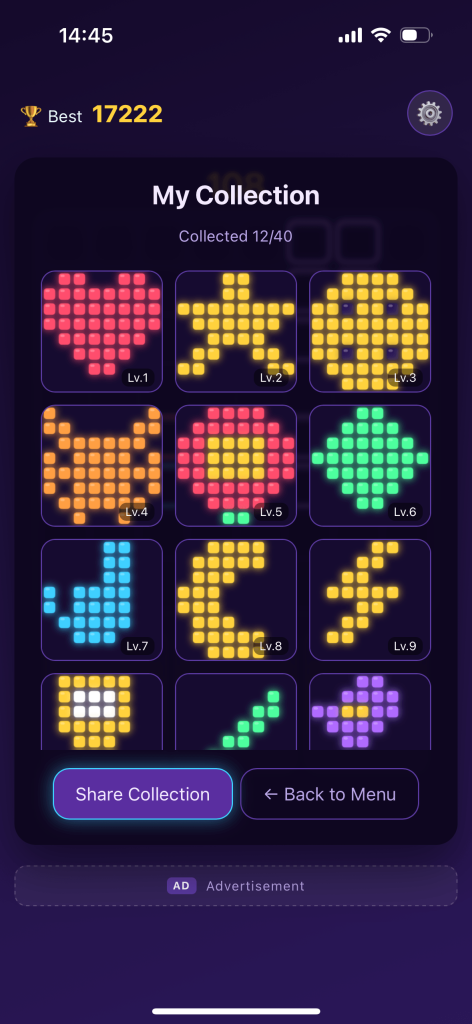
The Short Version
Here is the whole comparison in one table.
| Block placement puzzle | Match-3 | Falling-block game | |
|---|---|---|---|
| Core action | Drag a shaped block onto a grid | Swap two adjacent tiles to make a line of three or more | Steer and rotate pieces as they descend |
| Board | Typically an empty 8×8 grid you fill | A pre-filled grid of tiles that changes as you clear | A well that fills from the bottom up |
| Timer | Often none | Sometimes a move limit, sometimes a timer | Almost always continuous |
| Rotation | Usually not allowed | Not applicable, tiles are swapped | Central mechanic |
| How you lose | No available piece fits anywhere | You run out of moves before reaching the goal | The stack reaches the top |
| Main skill | Spatial planning and space management | Pattern recognition and cascade planning | Speed, reaction and anticipation |
| Typical session | Two to ten minutes, self-paced | A level at a time | A run that ends when you do |
The single most useful line in that table is the one about the timer. It explains more about how a game feels than any amount of visual design.
Block Placement Puzzles: Space Is the Only Clock
A block placement puzzle gives you an empty grid, usually 8×8, and a tray of geometric shapes. You drag each shape onto the board. When a full row or full column is occupied, that line clears and the space comes back to you. Clear several lines with one placement and you get a combo. Shapes normally cannot be rotated. The run ends when none of the shapes currently in the tray can fit anywhere on the board.
Neon Block Blast follows that structure exactly. Blocks are dragged from a tray onto an 8×8 grid, full rows and columns clear, combos are rewarded, blocks cannot be rotated, and there is no timer. It adds two modes: an endless Classic mode and an Adventure mode with more than 40 handcrafted levels built around ice, wood and stone obstacles, plus Bomb and Hammer boosters. Those additions change the content, not the underlying rules; we break them down in the Adventure mode guide.
The important thing about this genre is that nothing happens unless you make it happen. No piece falls while you think. No board state expires. The grid only gets worse when you place something, which means every mistake is legible: you can point to the exact placement that cost you the run. That makes the genre unusually good at teaching planning, because cause and effect are never separated by a clock.
It also means the pressure is entirely internal. Space is the resource, and it shrinks with every move. You are not racing an opponent or a countdown; you are managing a finite board. If you enjoy the moment of sitting back and reading a position before committing, this is the family to look at. The ten block puzzle tips are essentially a list of ways to get better at that reading.
There is a reason we wrote an entire studio note about why we left the timer out. In a genre where the whole point is considered placement, a countdown does not add excitement so much as it removes the thing players came for.
Match-3: Swapping, Matching and Cascades
Match-3 starts from the opposite place. Instead of an empty grid, you are given a board already full of coloured tiles. You swap two adjacent tiles so that three or more of the same kind line up. Those tiles disappear, tiles above fall into the gaps, and new ones arrive from the top. Sometimes the falling tiles form new matches on their own, which is called a cascade, and a well-planned swap can set off a chain of them.
Where a block puzzle asks “where should this shape go?”, match-3 asks “which swap unlocks the most valuable chain?” The skill is pattern recognition combined with a bit of forward modelling: you look for a swap that not only clears now but leaves the board in a state where the refill is likely to clear again. Special tiles and level goals add another layer, so a single move can be judged by how it serves a target rather than by how many tiles it removes.
Failure conditions vary more here than in the other two genres. Many match-3 levels give you a limited number of moves to reach a goal, such as clearing certain tiles or collecting a number of items. Others use a timer. Either way, the constraint is usually explicit and external: a counter you can see ticking down. That is a very different feeling from an endless block grid, where the constraint is the board itself.
Match-3 also tends to be more forgiving of a single bad move early on, because the board keeps refilling and a cascade can rescue you. It is less forgiving of a bad plan near the end of the move limit. The genre rewards people who enjoy optimising a sequence and watching a chain reaction pay off.
Falling-Block Games: The Clock Is the Opponent
The third family is the one most people meet first in some form: pieces descend from the top of a well, and you move and rotate them before they land. Completed horizontal lines clear; the stack creeps upward; when it reaches the top, the run ends. Later pieces arrive faster.
Rotation is central here, and that is the sharpest mechanical contrast with block placement puzzles. In a falling-block game, the ability to turn a piece is part of the basic vocabulary. In Neon Block Blast, the inability to rotate is a deliberate rule that forces you to plan around the shapes you actually have. Two genres, same word “block”, opposite design decisions.
Time is also non-negotiable in the falling-block family. The piece keeps coming whether you are ready or not, and the difficulty curve is largely a speed curve. That makes these games excellent for reaction, anticipation and flow, and a poor fit for someone who wants to pause mid-move to think about dinner. The pressure comes from outside, continuously, and it does not stop while you read the board.
None of this makes one genre better. It explains why the same person can love one and bounce off another in five minutes.
What Each Genre Asks of Your Brain
It is tempting to call all of these “brain training”, but the more useful question is what kind of thinking each one exercises.
Block placement puzzles lean on spatial reasoning and working memory. You hold several shapes in mind, imagine where each could fit, and project how a placement will change the board two or three moves later. Because there is no timer, the limiting factor is how well you can model the grid, not how fast. Our article on block puzzles and spatial reasoning goes into this in more detail, including a note on the limits of what a casual game can and cannot claim.
Match-3 leans on visual pattern recognition and planning under an explicit budget. You scan a dense board for candidate swaps, rank them, and think about how the refill will behave. It is less about empty space and more about reading a crowded field and predicting a chain.
Falling-block games lean on rapid perception and motor planning. You identify a shape, decide where it goes, and execute before it lands, repeatedly, while the tempo increases. Short-term anticipation matters, but deliberation is a luxury.
If you are choosing a game for a child, for a commute, or for winding down at night, this distinction matters more than the art style. A fast falling-block game is a stimulating way to spend ten minutes. A timer-free block grid is closer to a quiet sorting task with a score attached.
Failure Conditions Compared
How a game ends shapes how it feels long before it ends.
| Genre | What ends the run | Can you pause mid-decision? | Is a comeback possible? |
|---|---|---|---|
| Block placement | No available shape fits the grid | Yes, indefinitely | Only until the board is truly jammed; a well-timed booster can reopen it |
| Match-3 | Move or time budget runs out before the goal | Usually yes, but the budget is fixed | Often, via a cascade or special tile |
| Falling block | The stack reaches the top | No, pieces keep descending | Only by clearing lines quickly under pressure |
The “can you pause” row is worth dwelling on. A game that lets you stop and think is a different product from one that does not, even if the screenshots look similar. It changes who can play it, when they can play it, and whether it feels like a break or a test. That is the main reason timer-free grid puzzles work so well in the small gaps of a day: waiting rooms, queues, a train between stations, the two minutes before a meeting.
Which One Fits a Five-Minute Break?
A short break has three awkward properties: it can be interrupted without warning, you may not know how long it will last, and you do not want to be left with a feeling of having failed something. A timer-driven game handles all three badly. An interruption costs you the run, an uncertain length means you cannot choose a suitable level, and a fast loss is a small but real spike of frustration.
A timer-free block grid handles them well. Nothing expires while you are away, there is no level timer to outrun, and closing the app mid-board costs nothing because progress is saved on the device. Neon Block Blast is fully playable offline and saves automatically, which is also why it works on a plane or in a tunnel where a connection disappears. If that combination, no timer, no Wi-Fi, no account, is what you are after, the relaxing offline puzzle games guide lays out a checklist for judging any game in this category.
Match-3 sits in the middle. A level is short and self-contained, so it fits a break, but a move limit means an interruption can leave you mid-problem. Falling-block games are the best choice when you want to be energised rather than calmed, and the worst choice when you might be interrupted at any second.
Timers, Offline Play and Monetisation
One more difference that rarely shows up in genre comparisons is the business model, because it changes the texture of a session. Many puzzle games gate play with energy systems, subscriptions or a hard wall after a number of levels. Others are free with ads and offer a one-time purchase to remove them.
Neon Block Blast belongs to the second group. It is free to download and play, contains ads, and offers an optional one-time in-app purchase that removes ads permanently. There is no subscription and no energy meter. We explained the thinking behind that in the guide to free puzzle games without subscriptions; the short version is that a casual puzzle should not require a recurring commitment.
That model pairs naturally with a timer-free, offline game. If the game does not need a server to run, there is no reason to put a server-shaped limit in front of it. When you are comparing genres, it is worth checking not just the rules but what the game asks of you after the twentieth session.
Two Games, Two Very Different Puzzles
Our studio works on both sides of this comparison, which is why the distinction is more than theoretical for us. Neon Block Blast is a block placement puzzle: an 8×8 grid, shapes you drag in, no rotation, no timer, endless Classic play plus an Adventure mode with obstacles. Adorable Pet Crush is a cozy match-3 adventure: a pre-filled board of adorable pets, swaps, combos and a progression of levels.
They share almost nothing mechanically. One is about empty space and planning; the other is about reading a crowded board and setting off chains. We build both because people genuinely want both moods. Some evenings you want to quietly fit shapes into a grid with no clock anywhere on the screen. Some evenings you want bright pets, cascades and the satisfaction of finishing a level. Neither is a “better” puzzle; they are different instruments.
If you are unsure which of our two games suits you, the fastest test is the timer question. If you want to be able to put the phone down mid-move without consequence, start with Neon Block Blast.
How to Choose
- You want to think, not react: choose a block placement puzzle with no timer.
- You want visible progress and level goals: choose a match-3 or a level-based block puzzle mode.
- You want an adrenaline curve and rising speed: choose a falling-block game.
- You get interrupted constantly: avoid continuous timers and anything that needs a live connection.
- You dislike being asked to subscribe: check the store listing for a one-time ad-removal purchase instead of a recurring plan.
- You are choosing for a short commute: prioritise offline play, autosave and a run you can close at any point.
Frequently Asked Questions
Is a block puzzle the same as Tetris? No. Falling-block games involve continuous descent and rotation; block placement puzzles give you a tray of fixed-orientation shapes to place on a static grid, usually with no timer.
Is match-3 harder than a block puzzle? They are hard in different ways. Match-3 tests pattern recognition and planning under a move budget. Block puzzles test spatial planning against a shrinking supply of empty cells.
Why do some puzzle games have timers and others do not? A timer creates urgency and a difficulty curve based on speed. Removing it makes the game about deliberation instead, which suits short, interruptible sessions better.
Can you rotate blocks in Neon Block Blast? No. Shapes arrive in a fixed orientation, so you plan around the pieces you are given. That is one of the clearest differences from falling-block games.
Which puzzle genre is best for relaxing? For most people, a timer-free block placement puzzle: nothing falls, nothing expires, and closing the app costs nothing. See our no-timer design note for why we made that choice.
Do these games work offline? It varies by title. Neon Block Blast is fully playable offline and saves progress on the device; always check the store listing for the game you are considering.
Is Neon Block Blast free? Yes, free to download and play with ads, plus an optional one-time purchase that removes them. The full Neon Block Blast FAQ answers the common follow-ups.
Where do I start if I want to get better at block puzzles? Learn to protect open rows, read the whole tray before placing, and set up multi-line clears. The block puzzle tips guide covers ten concrete habits.
Try the Quiet One First
If this comparison resolved anything, it is probably that you know which kind of attention you have available. For the interruptible, no-clock version, Neon Block Blast puts an 8×8 grid, two modes, offline autosave and no timer into one free install. Developed and published by Shenzhen Jinjie Network Technology Co., Ltd., it is available on Google Play. Read the full review first if you want the complete picture.
Download Neon Block Blast on Google Play: https://play.google.com/store/apps/details?id=com.jinjie.neonblast
Further reading: games like Block Blast and how to choose an alternative and what defines a Block Blast-style 8×8 puzzle.
Views: 0