We tend to reach for a phone game during the gaps in the day — the wait for a train, the ten minutes before a meeting, the quiet half hour before bed. Those are moments when we want to switch off. Yet a surprising number of the games we open in those moments are built to do the opposite: a countdown in the corner, a streak that breaks if you miss a day, a notification nudging you back, a leaderboard quietly turning a break into a performance review.
That mismatch is worth taking seriously. A game designed around urgency is not a neutral way to fill time; it carries a small but real cognitive cost. If the goal is to unwind, the design of the game matters as much as the amount of time you spend on it. Two features in particular separate the games that actually help from the ones that only feel like they do: no timer and offline play. This guide looks at why those two things change the experience, how the main casual puzzle genres compare, and what to look for when choosing something to keep on your phone.
The Problem With Timed Games
Timers are not inherently bad. In an arcade game, a countdown creates excitement, and for players who want a burst of adrenaline that is exactly the point. But a timer also does something less obvious: it removes your ability to stop and think.
Under time pressure, you stop evaluating options and start reacting. You place the piece that roughly fits instead of the one that fits best. You tap the first match you see. The activity becomes a sequence of small reflexes rather than a sequence of small decisions, and the mental state it produces is closer to vigilance than to rest. Add a daily streak or a limited number of lives and the game acquires an obligation: you are no longer playing because you want to, you are playing so you do not lose something.
For anyone using a puzzle as a wind-down, that is the wrong trade. The whole appeal of a puzzle is the mild, satisfying effort of working something out — and that effort needs room to breathe.
What “No Time Limit” Actually Changes
Remove the clock and the same board becomes a different activity.
First, you are allowed to be thorough. You can look at all the available pieces, mentally test two placements, notice that one of them would block a nearly complete line, and choose the other. The game rewards attention instead of penalizing it. That is a small shift, but it turns a reflex exercise into a genuinely absorbing one — the kind of quiet concentration people describe as relaxing rather than draining.
Second, you control when the session ends. A timed game ends when the clock says so, which often arrives at an inconvenient moment. A game with no timer ends when you decide: when your stop comes, when your food arrives, when you are simply done. There is no half-finished round pulling at your attention.
Third, failure feels fairer. With no clock to blame, outcomes come from your own choices. That makes improvement tangible — you can tell exactly which placement cost you the run — and it makes the game easier to put down without a lingering sense of being interrupted.
A practical note: no timer pairs especially well with autosave. If the game remembers your board, you can close it mid-thought and return to the identical position later. That combination is what makes a puzzle genuinely compatible with real life rather than requiring you to carve out an uninterrupted block of time.
Why Offline Play Still Matters
It is easy to assume connectivity is a solved problem. In practice, the moments when we most want a quick game are exactly the moments when the connection is worst.
Underground and in transit. Subways, tunnels, and trains are the classic dead zones, and they are also where a two-minute puzzle is most welcome. Flights and travel. Airplane mode, roaming limits, and expensive airport data all make an offline game the only reliable option. Weak signals in buildings. Basements, elevators, large concrete offices, and rural areas still produce the spinning “connecting” screen. Data and battery. A game that does not need to talk to a server or stream an ad every few seconds is kinder to both your plan and your battery. Shared or child devices. A tablet without a SIM card, or a hand-me-down phone kept for games, may never be online at all.
There is also a subtler benefit: an offline game does not need to check in. No login wall, no account creation, no “syncing progress” spinner between you and your first move. Progress saved locally on the device means the game is ready the instant you open it. For a title meant to fill a short gap, that frictionless start is a real feature.
When evaluating a casual game, “works offline” should mean the core loop is playable without a connection — not merely that the app opens and shows a cached menu. Check that the actual puzzle is playable in airplane mode.
Block Puzzle vs Match-3 vs Falling-Block
“Puzzle game” covers several quite different experiences. Knowing which type suits you is more useful than reading any top-ten list.
| Block placement (8×8 grid) | Match-3 | Falling-block / arcade | |
| Core action | Drag shapes onto an empty grid to complete rows or columns | Swap adjacent tiles to make groups of three or more | Rotate and drop pieces as they descend |
| Time pressure | Usually none | Often move limits or level timers | Frequently a rising speed or clock |
| Board state | Persists until you clear it; you manage space | Clears and refills after each move | Constantly changing under you |
| Main skill | Spatial planning and space management | Pattern recognition and chain setup | Reflexes and quick decisions |
| Pause-ability | Very high — no state is lost when you stop | Moderate | Low |
| Typical mood | Calm, methodical | Bright, goal-driven | Energetic, tense |
Match-3 games are excellent when you want clear objectives and a sense of level-by-level progress, with colorful feedback on every move. They often introduce move limits, which adds pressure. Falling-block games are the adrenaline end of the genre — thrilling, but rarely restful. Block placement games sit at the other end: the board waits for you, nothing moves unless you move it, and the challenge is entirely about how you organize space.
If your goal is decompression rather than stimulation, the third column is usually the wrong place to look, and the first is usually the right one. That is not a judgement on quality — it is simply about matching the mechanic to the moment.
What to Look for in a Relaxing Puzzle Game
A short checklist makes it much easier to filter the store:
- No timer in the main mode, so you can think and stop on your own terms.
- True offline play — the puzzle itself works in airplane mode.
- Autosave, so an interrupted session is not a lost session.
- A lightweight install that runs smoothly on older or budget phones.
- Simple, honest monetization: free to play, with ads you can remove via a one-time purchase rather than a subscription or an energy system.
- No account required to start playing.
- Two depths of session — an endless mode for two minutes and a level-based mode for longer stretches.
- Clear visual feedback without constant flashing, noise, or pop-ups.
The last point is easy to overlook. A game can be mechanically calm but visually loud. Dark boards with crisp, purposeful effects tend to be easier on the eyes during an evening session than a wall of animated prompts.
A Good Example: Neon Block Blast
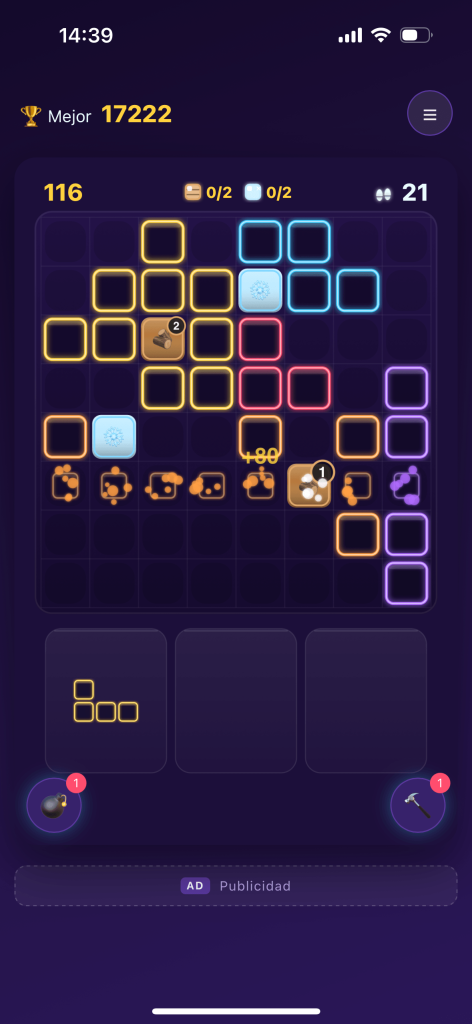
If you want a concrete place to start, Neon Block Blast is a tidy illustration of most of the above. It is a free casual block puzzle from Shenzhen Jinjie Network Technology Co., Ltd., built on an 8×8 grid where you drag shaped blocks into place and clear full rows or columns. There is no timer. Blocks cannot be rotated, so the game is about planning around the shapes you are given rather than reacting quickly.
Against the checklist: it plays fully offline with no Wi-Fi needed; it autosaves so you can quit and resume the same board whenever you like; the install is small and runs on Android 7.0 and above; it is free to download with ads and an optional one-time Remove Ads purchase; there is no account or login wall; and it offers two depths of session — an endless, relaxing Classic mode and an Adventure mode with 40-plus handcrafted levels featuring ice, wood and stone obstacles. Visually it uses glowing neon shapes on a dark board, with satisfying effects when lines clear, which fits the “calm but not dull” brief well.
Clearing multiple lines at once earns combo bonuses, and two earned power-ups — a Bomb that clears a 3×3 area and a Hammer that removes a single block — give you a way out when the board gets tight. It is a small, focused design: no timers, no falling pieces, no obligation to return tomorrow. You open it, you place a few shapes, you close it.
For a fuller breakdown, see our Neon Block Blast review. If you enjoy the format and want to get better at it, our block puzzle tips and high-score strategies cover ten habits that make runs last longer.
Building a Healthier Puzzle Habit
The game matters, but how you use it matters more. A few small choices make a bigger difference than any app:
Match the game to the moment. Use a no-timer, offline puzzle for the fragments of the day when you may be interrupted, and save anything with streaks or time limits for when you actually have time to sit down. Let the session end naturally. With no clock and autosave in place, stopping at your stop is easy — there is no round to finish. Play for the decision, not the number. Chasing a high score can quietly reintroduce the pressure you were trying to remove; on a calm game, the point is the small satisfaction of a tidy clear. Keep one game installed for this purpose. Having a single, familiar, offline option means you do not spend your break scrolling through the store deciding what to open. Turn off notifications for games. A relaxing game should not be the thing that interrupts you.
None of this requires a big change. It is mostly about noticing that a break works better when nothing in it is urgent.
Start With Something Simple
A good wind-down game asks very little of you: no connection, no countdown, no account, no streak to protect. It gives you a small, orderly problem, lets you solve it at your own pace, and lets you walk away the moment you need to. That is the whole appeal of timer-free offline puzzles, and it is why the genre keeps finding new players even as mobile games get louder.
Try Neon Block Blast free on Google Play: https://play.google.com/store/apps/details?id=com.jinjie.neonblast
Frequently Asked Questions
What makes a puzzle game relaxing? The absence of time pressure is the biggest factor. When nothing is counting down, you can think through each move, stop whenever you want, and treat the game as a short, self-contained activity rather than a task with an obligation attached.
Which games work without Wi-Fi or mobile data? Look for games whose core gameplay runs locally rather than requiring a server. Neon Block Blast, for example, is fully playable offline with no Wi-Fi needed, and saves progress on the device.
Is a block puzzle better than match-3 for unwinding? It depends on what you want. Match-3 gives colorful, goal-driven levels and often includes move limits. Block placement games like Neon Block Blast have no timer and a board that waits for you, which generally makes them calmer and easier to pause.
Do relaxing puzzle games require an account? They should not. Games that store progress locally let you start playing immediately with no sign-up, and they are usually the ones that work offline too.
Are free puzzle games with ads still worth it? Yes, provided the model is transparent. A free game supported by ads, with an optional one-time purchase to remove them, lets you try everything before deciding whether to pay. Watch out for energy systems and subscriptions instead.
Can I play a no-timer puzzle game in short bursts? That is what the format is best at. With autosave, you can close the app mid-board and resume exactly where you left off, which suits commutes and waiting time.
Is Neon Block Blast free? Yes. It is free to download and play, contains ads, and offers an optional one-time in-app purchase that removes ads permanently.
If you want to go further: how block puzzles exercise spatial reasoning, why we chose a free game with no subscription and the studio notes behind a timer-free puzzle.
Read next: the Adventure mode guide, block puzzle vs match-3 explained and the Neon Block Blast FAQ.
Further reading: games like Block Blast and how to choose an alternative and what defines a Block Blast-style 8×8 puzzle.
Views: 0