People rarely type “games like Block Blast” because they want another download link for the same app. They type it because they are looking for a feeling. Something about a particular kind of puzzle worked for them: no countdown in the corner, no pieces falling while they are still thinking, no punishment for putting the phone down halfway through a move. They want more of that, and they do not want to install six near-identical apps to find it.
The problem is that this genre is unusually easy to imitate on the surface. A grid, some brightly colored geometric shapes, a screenshot with a big score number — those visual cues are shared by hundreds of listings, and they tell you almost nothing about how a game actually behaves. Two puzzle games can look like twins in a store screenshot and feel completely different after ninety seconds. One lets you sit and reason for as long as you like. The other quietly starts a timer, locks content behind a lives system, or refuses to open at all when your train goes into a tunnel.
This guide is not a ranked list of apps with star ratings attached. It is a way to evaluate any block puzzle before you install it, built around the things that actually determine whether a game fits into your day. We will break down what people usually mean by this kind of search, look at the core mechanic worth preserving, give you a checklist you can apply to any store listing, and then walk through one specific game our studio publishes — with an honest account of where it fits and where it does not.
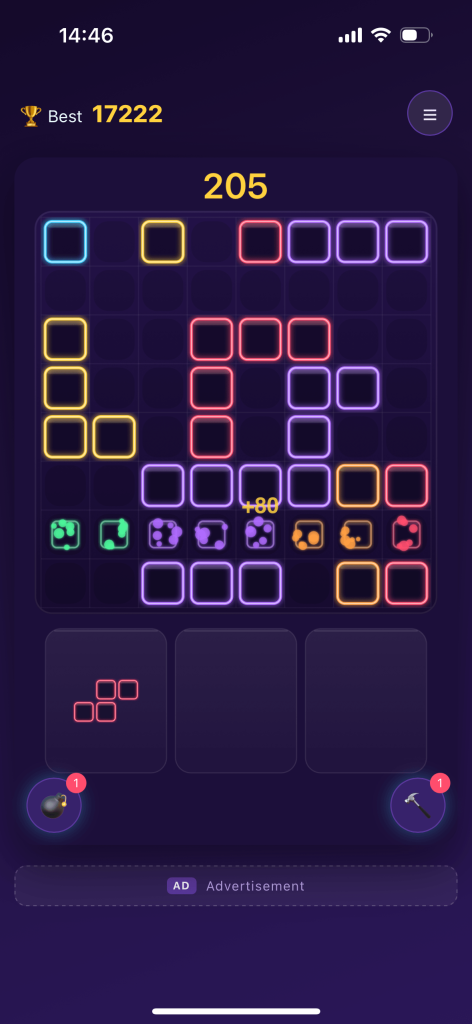
What People Actually Mean by “Games Like Block Blast”
Search phrases that begin with “games like” are rarely about a single feature. They bundle several different hopes together, and those hopes are worth separating, because the right alternative depends on which one matters most to you.
| What the person really wants | What to check in a listing | Typical disappointment |
|---|---|---|
| The same core mechanic | Grid size, drag-to-place, line clears, whether shapes rotate | A match-3 game that only looked similar in the thumbnail |
| The same unhurried pace | A timer, falling pieces, move limits | A countdown that turns a break into a reflex test |
| The same circumstances of play | Offline support, local saving, device requirements | A game that needs a connection on the commute |
| The same fairness | Energy systems, forced ads, pay-to-win boosters | Progress that stops until you watch or pay |
| Something new after the habit forms | Level content, obstacles, a second mode | An endless board that feels identical on day thirty |
The first row is the one most guides fixate on, but in practice the second and third rows are what make people uninstall. A game can have a perfect 8×8 board and still be wrong for you if it demands a network connection on the subway, or if a timer makes every move feel like a small deadline. When you are comparing alternatives, decide first which of these rows is non-negotiable, then use the rest as tie-breakers.
There is also a naming problem worth acknowledging. This format has been called block puzzles, block placement puzzles, 1010-style puzzles, drop puzzles, and — increasingly — “Block Blast-style” puzzles, after one of its best-known titles. Stores do not use a single consistent category for it. That means searching by genre name alone will miss good options, and searching by a brand name will mostly return that brand. The practical workaround is to search for the rules you want — “8×8 block puzzle no timer”, “offline block puzzle” — rather than only for a title. We explain the format itself in more detail in our guide to block blast style puzzle rules.
The Mechanic Worth Keeping
Underneath the neon gradients and the score counters, the format is defined by a short, unusually clean rule set. You get a square board — commonly 8×8 — and a tray holding a small set of geometric shapes. You drag shapes from the tray onto empty cells. Shapes cannot be rotated. When an entire row or an entire column is filled, it clears, and the space returns to you. Clear more than one line with a single placement and you earn a combo bonus. New shapes arrive as you use the old ones. When none of the shapes in the tray can fit anywhere on the board, the run ends.
That is almost the whole game. There is no timer, no gravity pulling pieces down, no hidden resource meter, and no opponent. The tension comes from one source: finite space. Every placement is a small bet about which empty cells will be useful to you three shapes from now.
Why does this particular rule set travel so well between games? Because each constraint does a job. A fixed grid makes the state of the board completely visible; nothing is hidden behind a queue or off-screen. Non-rotating shapes make the tray a real constraint rather than a formality — the shape you are given is the shape you must place. Line clears create a rhythm of pressure and relief, and combos reward the one habit that separates a short run from a long one: thinking about several placements at once instead of just the next one.
When you evaluate an alternative, verify these rules instead of assuming them from the screenshots. Some games in adjacent genres let you rotate pieces, add falling blocks, impose a move limit, or replace the “no space left” ending with a lives system. Those are legitimate designs, but they produce a different experience. If what you liked was the calm, deliberate board, a game that adds a timer has changed the thing you came for. Our block puzzle vs match-3 comparison covers the wider family of genres if you want to map the differences more systematically.
A Practical Checklist Before You Install
Here is the checklist we would use on any listing. None of these items requires you to install the app first — most can be confirmed from the store description, the screenshots, or the first two minutes of play.
| Check | Why it matters | How to verify |
|---|---|---|
| No timer, no falling pieces | Keeps the game interruptible and unhurried | Description says “no time limit”; screenshots show no countdown |
| Shapes are fixed, not rotatable | Makes planning around the tray meaningful | Look for “cannot be rotated” or test one piece |
| Full rows and columns clear | The core feedback loop of the format | Usually stated in the first two lines of the description |
| Combo rewards for multi-line clears | Gives the format its depth | Description or the on-screen score popup |
| Playable offline | Works on commutes, flights and patchy connections | Explicit “offline” claim; test in airplane mode |
| Progress saved locally | Lets you close the app mid-board | Look for autosave or “resume where you left off” |
| No energy or lives system | Nothing stops a session except the board | Scan for “lives”, “energy”, “wait to continue” |
| Ads are optional, not a gate | You decide when to watch, not the game | Check for rewarded or optional ads versus forced interstitials |
| One-time ad removal, no subscription | Predictable cost if you play daily | In-app purchase list; look for “remove ads” |
| A second mode or level content | Gives you somewhere to go after the endless habit | Check for levels, chapters or obstacles |
| Readable grid on a small screen | Reduces misplacements from fat-finger drags | Screenshots on a phone, not a tablet render |
This is also a useful way to read a store description critically. Vague phrases like “relaxing puzzle fun” are not evidence of anything. Concrete claims — “no timer”, “works offline”, “shapes cannot be rotated”, “one-time purchase to remove ads” — are verifiable, and a developer who lists them is usually confident about them. If a listing never mentions a timer either way, assume there may be one until you have checked.
No Timer, No Pressure
Of all the items above, the timer is the one that changes the game most. A countdown does not simply make a puzzle harder; it changes what kind of thinking is available to you. Under time pressure, the sensible move is the first adequate placement. Without it, the sensible move might take twenty seconds of reading the tray, comparing the shapes against the gaps, and noticing that a nearly complete column is one cell away from clearing.
That difference matters most on the exact occasions people open a casual puzzle: waiting for a bus, sitting in a queue, decompressing between tasks, or playing with one hand while something else is going on. Those are interruptible moments. A game that lets you stop mid-deliberation and come back to an unchanged board fits them. A game that keeps moving while you look away does not. We wrote about the design reasoning in more depth in why we built a puzzle with no timer and in our guide to relaxing offline puzzle games without time limits.
A useful test: open the game, then do nothing for thirty seconds. If nothing has changed on the board, the game respects your attention. If pieces have dropped, a bar has emptied, or you have lost a life, you are looking at a different genre wearing similar clothes.
Playing Offline and Keeping Your Progress
Offline support sounds like a minor convenience until you need it. Underground trains, lifts, aircraft, rural coverage, a data cap near the end of the month, or a child’s tablet with no account on it — these are ordinary situations for a phone game, and a puzzle that requires a server to render a board is needlessly fragile in all of them.
There is a related question that gets less attention: where your progress lives. For a single-player puzzle, local autosave is usually the more dependable model. The board is small, the state is simple, and saving it on the device means a dropped connection cannot cost you a run. When you compare alternatives, look for an explicit statement that the game saves your progress and that you can resume a board after closing the app. If a listing talks only about cloud sync or leaderboards, check whether a network connection is required to start a session at all.
Also worth checking: how much space the install takes and which Android versions it supports. A lightweight puzzle has an advantage on older phones and on devices with limited storage, and it is one of the reasons this format remains popular on hardware that struggles with bigger titles. Our Neon Block Blast FAQ collects the concrete answers for our own game, including offline play, saving and the free-to-play model.
Free Without the Friction
Most games in this format are free to download, and that is worth taking seriously rather than treating as a trick. The honest version of the model is simple: the game is free, it contains ads, and there is an optional purchase that removes them. Nothing else is gated. No energy meter, no pay-to-win boosters, no level that cannot be finished without spending.
The word “optional” is doing real work there. There is a meaningful difference between ads that appear between runs and ads that block the next move, and between a one-time ad removal and a recurring subscription. If you play a puzzle for ten minutes a day for a year, a subscription and a one-time purchase are very different propositions. We go into the economics — and why we prefer the simpler version — in free puzzle games without subscriptions.
Be sceptical of listings that promise “no ads” without explaining how the game is funded, and equally sceptical of ones that hide the purchase model entirely. A clear sentence about ads in the description is a good sign. It means the developer expects you to still be playing after you find out.
Content That Lasts: Endless Boards and Designed Levels
An endless board is a wonderful first week. You learn the rules, your high score climbs, and the feedback loop is immediate. Around week three, some players want a different question. Instead of “how long can I keep this alive?”, they want “can I solve this particular board?”
That is why the alternatives worth keeping usually offer a second structure. Levels with fixed starting positions and built-in obstacles change the skill being tested: you are no longer managing a long-run average but reading a specific configuration and finding the sequence that unlocks it. Obstacles that occupy cells, or that need more than one clear to remove, change the geometry without changing the placement rules, which keeps the learning curve gentle.
Our own game splits content this way. Classic mode is the open-ended board. Adventure mode adds more than 40 handcrafted levels with ice, wood and stone obstacles, plus two boosters — a Bomb that clears a 3×3 area and a Hammer that removes a single block — earned by clearing lines. The full breakdown is in the Adventure mode guide. When you assess another game, ask whether it has an equivalent second act. If the only content is a high-score chase, that is fine, but it is a different long-term proposition.
Visual Clarity and One-Handed Play
Aesthetics are not the reason to choose a puzzle, but readability is. This genre asks you to judge exact cell positions, often on a phone, often one-handed, sometimes in bright daylight. High-contrast shapes against a dark or clearly delineated grid make that judgement easy; pale pieces on a pale board make it tiring. Neon styling has become common in the genre for a reason — glowing edges make it obvious where one shape ends and the next begins.
Check the screenshots for a visible grid, a readable score, and a tray that shows all available shapes at once. If the tray only reveals one piece at a time, the planning layer of the format is gone. And if the drag targets are small enough that you regularly misplace a shape, no amount of strategic thinking will save the run. This is a small point that becomes a large one over hundreds of moves.
A Note on Names and Trademarks
“Block Blast” is a trademark belonging to its respective owner. We use the phrase on this page descriptively, in the sense of the widely known 8×8 block-placement puzzle format, because that is how readers search for this kind of game. We are not affiliated with, endorsed by, or sponsored by that publisher, and nothing here is an official statement about its product. Neon Block Blast is a separate game, developed and published by Shenzhen Jinjie Network Technology Co., Ltd. We mention this explicitly because comparison searches are exactly where brand confusion is most likely, and clarity is better for everyone — readers, publishers and search engines alike.
One Option That Meets the Checklist
With that disclosed, here is how our own title lines up against the checklist above. These are only features listed on its Google Play page; we are not adding anything speculative.
| Checklist item | Neon Block Blast |
|---|---|
| No timer, no falling pieces | Yes — there is no time limit and no gravity |
| Shapes cannot be rotated | Yes, the pieces are placed as given |
| Full rows and columns clear | Yes, with combo bonuses for multiple lines at once |
| Boosters | Bomb (clears a 3×3 area) and Hammer (removes one block), earned by clearing lines |
| Offline play | Yes, fully playable without a connection |
| Progress saved | Yes, autosave on the device |
| Energy or lives system | None |
| Ads | Included; a one-time purchase removes them |
| Second act | Adventure mode with more than 40 levels and ice, wood and stone obstacles |
| Grid | 8×8, neon-styled |
| Requirements | Android 7.0 and above; English plus dozens of other languages |
| Package | com.jinjie.neonblast |
Where it may not be the right fit: if you specifically want competitive leaderboards, daily challenges, or a level editor, you should look elsewhere — those are not features we claim. If you need the game on a platform other than Android, verify availability in the relevant store first — the release described here is the Android one. And if you want a game with no ads at any price, a free title supported by ads will not be it, though the one-time removal option exists. Being explicit about these limits is more useful than pretending a single game wins every comparison.
For a fuller account of the modes, power-ups and the free-to-play model, see our Block Blast review.
Switching Without Losing the Habit
If you are moving over from another game in the format, the transition is easier than it looks because the muscle memory transfers. A few things help:
Start in the endless mode rather than the levels. The board is empty, the rules reassert themselves quickly, and within a few runs your old instincts come back. Treat your previous high score as a baseline, not a target to beat on day one — the shape sets and combo rules vary slightly between implementations, and early scores are not comparable.
Resist using a booster the moment the board looks crowded. Boosters are most valuable when one specific cell is preventing a line from completing, not as a general panic button. Our ten tips for higher block puzzle scores covers the habits that actually extend a run: protecting the center, reading the whole tray before placing, and keeping large contiguous empty areas instead of scattered single cells.
Give it two or three days before deciding. The format’s appeal is cumulative; the satisfying part is recognizing a board shape you have seen before and knowing exactly which piece will unlock it. That recognition cannot be judged from one session.
Frequently Asked Questions
What does “games like Block Blast” actually refer to? Usually the 8×8 block-placement format: drag non-rotating shapes onto a grid, clear full rows and columns, and keep the board alive as long as possible. See what defines a block blast style puzzle for the full rule set.
Are games in this format free? Most are free to download. The common model is ads plus an optional purchase that removes them. Check the in-app purchase list for subscriptions before committing.
Do they work offline? Some do, some do not. Look for an explicit offline claim and test in airplane mode if it matters to you. Neon Block Blast is fully playable offline.
Can shapes be rotated? In the classic format, no — that constraint is a large part of the strategy. Other games may allow rotation, which produces a noticeably different experience.
Is there a time limit? It varies. A game with a countdown is a different design, even if the screenshots look similar. Confirm this before installing if an unhurried pace is what you want.
What ends a run? In the standard format, the run ends when none of the shapes in the tray can fit anywhere on the board. There is no timer and no life count.
Are there levels, or only an endless board? Depends on the game. Neon Block Blast includes both an endless Classic mode and an Adventure mode with more than 40 levels and obstacles.
Does the game save my progress? Neon Block Blast autosaves on the device, so you can close it and return to the same board. For other titles, look for an explicit autosave or resume claim.
Is Neon Block Blast made by the same company as Block Blast? No. It is a separate game from Shenzhen Jinjie Network Technology Co., Ltd. See the trademark note above.
Where to Start
The short version: decide which of the five hopes behind your search matters most, apply the checklist to the listing, and give any candidate a two-minute test with a timer-free, offline board. If the format is what you are after, the rules matter far more than the screenshot.
Neon Block Blast is developed and published by Shenzhen Jinjie Network Technology Co., Ltd. It is free on Google Play, works offline, and includes both Classic and Adventure in the same install.
Download Neon Block Blast on Google Play: https://play.google.com/store/apps/details?id=com.jinjie.neonblast
Related reading: block puzzles and spatial reasoning and the Neon Block Blast FAQ.
Views: 0