Puzzle games get described in two very different ways. One camp calls them a harmless way to fill a few minutes. The other calls them “brain training,” sometimes with promises that no mobile game could honestly make. The truth sits somewhere in between, and it is more interesting than either version.
A well-designed block placement puzzle does ask something real of you. It asks you to hold shapes in your mind, imagine where they could go, weigh two or three moves against each other, and live with the consequences of a decision you made thirty seconds ago. Those are genuine cognitive operations — the same ones you use when packing a car boot, arranging furniture in a small room, or planning a sequence of tasks. Whether a game makes you “smarter” is a much bigger claim than the evidence supports. But whether a game gives your spatial reasoning and planning a focused, enjoyable workout is a much easier question to answer, and the answer is yes.
This article looks at what block puzzles actually engage, why the specific rules of the genre matter, how they compare with other brain games, and how to play them in a way that is genuinely mentally active rather than half-distracted. We will use Neon Block Blast as the concrete example, because its rule set is a clean, uncluttered version of the format.
What “Brain Training” Should — and Shouldn’t — Mean
It helps to be precise about the term. “Brain training” is often used to suggest that practising a game will produce broad, lasting improvements in general intelligence, memory, or everyday performance. That is a strong claim, and a casual puzzle game should not make it. Transfer from a specific game task to unrelated real-world abilities is notoriously difficult to demonstrate, and no free mobile puzzle is a clinical tool or a substitute for sleep, exercise, learning, or social contact.
What a puzzle game can honestly offer is narrower and still worthwhile: structured practice in a specific set of skills. Every time you work out whether an L-shaped piece will fit in a gap, you are doing spatial reasoning. Every time you decide to clear a line now rather than hold it for a bigger combo later, you are weighing a short-term cost against a longer-term benefit. Repeated, attentive practice of a skill is how that skill gets sharper within the activity itself, and many people simply find that state of focused problem-solving satisfying.
So the useful question is not “will this raise my IQ?” It is “what does this game make me do, and am I doing it attentively?” The rest of this article answers the first half of that question.
The Skills a Block Placement Puzzle Actually Engages
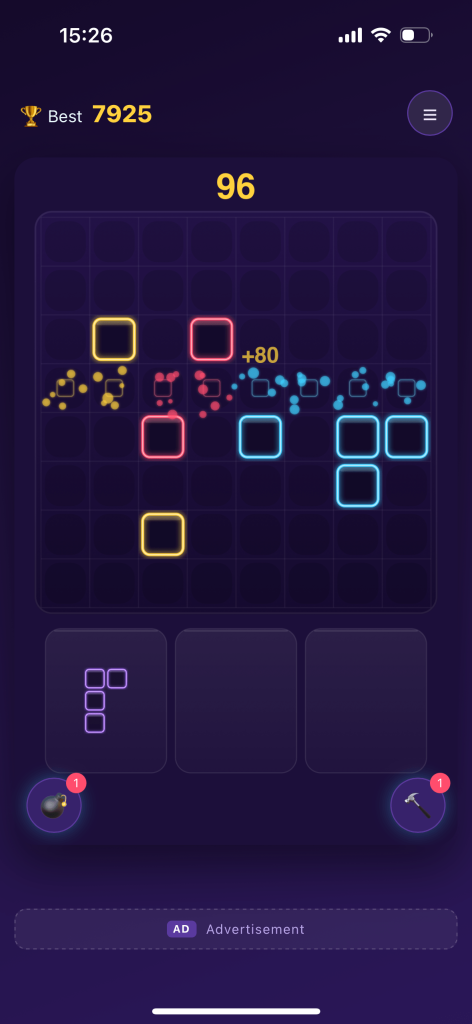
The classic format is straightforward: an 8×8 grid, a tray of geometric shapes, and one rule for removing anything — complete a full row or column and it clears. In Neon Block Blast, shapes cannot be rotated, there is no timer, and the run ends when no available piece fits. Those four constraints generate a surprisingly rich set of mental demands.
Spatial reasoning and mental rotation (even without rotation)
Normally, grid puzzles ask you to mentally rotate a piece before placing it. Here, rotation is not allowed, which sounds like it removes a skill — but it actually shifts the burden. Because you cannot turn a piece to fit a gap, you must evaluate the board as it is: is there an unoccupied region whose shape exactly matches this piece in this orientation? That is a form of shape-to-space matching, and it is arguably more demanding than simply spinning a piece until it fits. You are reading geometry rather than adjusting it.
You also start to see the board in terms of regions rather than cells. A cluster of six empty squares in a 2×3 rectangle is a resource; six empty squares scattered as isolated singles are effectively useless. Learning to see that difference at a glance is a spatial skill, and it is the single biggest factor in how long a run lasts.
Planning and working memory
A board that persists between moves forces you to carry a plan. You place a piece not because it fits now, but because it leaves a gap that a shape in the tray will fit into next. That means holding several items in mind at once: the current board, the shapes available, the line that is one cell from completion, and the consequence of each candidate placement. In cognitive terms, that is working memory plus forward planning, and it is why two players of equal reflexes can produce wildly different results.
Decision-making under constraints
Every placement is a trade-off. Do you take the safe single-line clear right now, or keep three lines nearly full in the hope of a multi-line combo? Do you spend the Bomb on this moderately congested corner, or save it for a worse jam later? There is no correct answer independent of context, so you are constantly estimating risk with incomplete information. That is a more interesting mental exercise than a puzzle with a single predetermined solution.
Selective attention and error monitoring
Because a single careless placement can fragment the board irreparably, the game rewards a habit of checking your own work: re-scanning the grid after every clear, noticing that a nearly complete row has been blocked, catching the mistake before it compounds. That loop of acting, checking, and adjusting is a useful attentional habit, and it is one reason the format feels absorbing without being frantic.
Patience and impulse control
This one is easy to overlook. With no timer, there is no external pressure to move — so the main source of bad decisions is your own impulse to place the obvious piece quickly. Choosing to pause, read the whole tray, and test an alternative is a small but repeated exercise in overriding the easy response. We wrote about the practical side of this in our block puzzle tips and high-score strategies.
Why the No-Timer Format Matters for Thinking
Time pressure changes the nature of a task. Under a countdown, people stop comparing options and start reacting; the goal shifts from choosing well to choosing fast. That is perfect for an arcade game and actively counterproductive if what you want is deliberate reasoning.
Remove the clock and the same board invites a different approach. You can count the empty cells in each line, mentally simulate two placements, notice that one would isolate a single square, and pick the other. Nothing punishes you for the extra ten seconds. In fact, the game quietly rewards it, because a considered placement almost always preserves more usable space.
There is a second benefit: the thinking can be interrupted. Neon Block Blast autosaves, so you can stop mid-deliberation, close the app, and return to the identical board. That makes the game compatible with real attention spans rather than demanding an uninterrupted block of focus. We explored the broader design reasoning in why we built a block puzzle with no timer, and the relaxation angle in our guide to relaxing offline puzzle games without time limits.
The “Cannot Rotate” Rule Is a Design Choice, Not a Limitation
It is worth dwelling on this, because it is the most counterintuitive decision in the game and the one that most clearly separates a thinking game from a fiddling game.
If blocks could be rotated, most awkward situations could be solved by adjusting the piece. That is satisfying in its own way, but it reduces the importance of reading the board in advance. With rotation removed, the pieces you are given are non-negotiable facts. You must plan around them, place the least flexible shape first, and keep your empty space in shapes that can accommodate a variety of fixed orientations.
This turns the game into an exercise in anticipation rather than correction. You are not fixing mistakes after they happen; you are arranging conditions so that future pieces have somewhere to go. That is precisely the kind of forward-looking, constraint-aware reasoning that makes the format mentally engaging rather than merely busy.
How Block Puzzles Compare With Other “Brain Games”
Different puzzle genres emphasise different abilities. Choosing one is less about which is “best for your brain” and more about which kind of thinking you want to practise on a given day.
| Game type | Main demand | Pressure | Pause-ability | Best for |
| Block placement (8×8) | Spatial planning, space management, forward reasoning | None | Very high | Deliberate, unhurried thinking |
| Sudoku / number puzzles | Logical deduction, constraint propagation | None | Very high | Sustained, single-problem focus |
| Word puzzles | Vocabulary, pattern recognition | Often daily limits | High | Language and recall |
| Match-3 | Pattern spotting, chain setup | Move limits or timers | Moderate | Quick, goal-driven sessions |
| Falling-block / arcade | Reflexes, rapid visuomotor decisions | Rising speed | Low | Speed and adrenaline |
Two things stand out. First, block placement is one of the few formats that combines genuinely spatial reasoning with zero time pressure. Sudoku is equally calm but purely symbolic; falling-block games are equally spatial but rarely calm. Second, the persistent board means your earlier decisions remain visible and consequential — you cannot reset the thinking halfway through.
That combination is why the genre works both as a short break and as a small, deliberate mental exercise. It is not that one genre trains the brain and the others do not; it is that they ask for different kinds of attention.
How to Make It a Genuine Mental Workout
Playing attentively and playing on autopilot feel similar but are not the same activity. A few habits make the difference:
Read the whole tray before you touch the board. Treat each move as a short sequence rather than a single placement. Ask where all the available shapes will go, not just the one in your hand.
Say your reasoning silently. “This piece goes in the corner so the middle stays open” is a simple sentence, but verbalising the plan forces you to actually have one. It also makes it obvious when you are placing a piece for no reason.
Review the board after every clear. A cleared line changes the geometry of everything around it. Pausing to re-scan prevents you from executing an outdated plan.
Set a process goal, not a score goal. For one run, decide that you will never let the board get more than half full before clearing. For another, focus only on always placing the most awkward shape first. Process goals keep attention on decisions; score goals can pull you toward risky shortcuts.
Analyse how a run ended. When the board jams, look back three moves. Was there a point where a safe clear was available and you held out for a combo? That short post-mortem is where most improvement comes from.
Do not multitask. A puzzle played while half-watching a video is a perfectly fine way to relax, but it is not much of a thinking exercise. If the point is mental engagement, give the board your attention for the few minutes you are on it.
Keep sessions short. Ten focused minutes is more useful — and more sustainable — than an hour of diminishing attention. The game’s autosave makes stopping easy, which is a feature worth using.
A Note on Limits
A casual puzzle game is a leisure activity. It can be an absorbing way to practise spatial reasoning, planning, and focused attention within the game itself, and many people find that state enjoyable and settling. It is not a clinical intervention, it does not treat or prevent any condition, and it should not be presented as a substitute for the things that actually support cognitive health: adequate sleep, physical activity, learning, and connection with other people. It also is not a productivity hack — playing it will not make you better at your job.
Held at that scale, the claim is both honest and appealing: this is a small, well-made problem you can choose to think about carefully for a few minutes, with no cost to stopping whenever you like.
A Good Place to Start
If you want to try the format, Neon Block Blast is a clean example. It is a free casual block puzzle from Shenzhen Jinjie Network Technology Co., Ltd., built on an 8×8 grid where you drag shaped blocks into place and clear full rows or columns. Blocks cannot be rotated, there is no timer, and clearing multiple lines at once earns combo bonuses. Two earned power-ups — a Bomb that clears a 3×3 area and a Hammer that removes a single block — give you a way out of a jam.
It has two modes that suit different kinds of attention: an endless, relaxing Classic mode for open-ended practice, and an Adventure mode with more than 40 handcrafted levels featuring ice, wood and stone obstacles that change the geometry of the board. It autosaves, plays fully offline with no Wi-Fi needed, runs on Android 7.0 and above, and is free with ads plus an optional one-time Remove Ads purchase. For the full breakdown of features and the free-to-play model, see our Neon Block Blast review and our guide to free puzzle games without subscriptions.
Give your spatial reasoning a few minutes of practice — download Neon Block Blast free on Google Play: https://play.google.com/store/apps/details?id=com.jinjie.neonblast
Frequently Asked Questions
Do block puzzle games actually train your brain? They give you structured practice in specific skills — spatial reasoning, planning, working memory, and decision-making under constraints — within the game itself. Claims about broad, lasting improvements to general intelligence are not something a casual game can honestly make.
What cognitive skills does an 8×8 block puzzle use? Shape-to-space matching, forward planning, working memory (holding the board and the available shapes in mind), risk assessment, and self-monitoring after each move.
Why is a game with no timer better for deliberate thinking? Without a countdown, you can compare several placements and choose the best one instead of reacting to the first option. Nothing penalises the extra few seconds of thought.
Is “cannot rotate blocks” a bad design? No — it shifts the challenge from adjusting pieces to reading the board. Because shapes arrive in a fixed orientation, you have to anticipate what the board will need, which makes planning more meaningful.
Is a block puzzle better than Sudoku for brain training? They practise different things. Sudoku emphasises logical deduction with numbers; block puzzles emphasise spatial reasoning and space management. Neither is objectively superior — choose based on which kind of thinking you want.
How long should I play to get a mental workout? Short, focused sessions work well. Ten attentive minutes with a specific process goal is more valuable than a long distracted session. The game autosaves, so you can stop at any point.
Is Neon Block Blast a medical or clinical brain-training tool? No. It is a casual leisure puzzle game. It is not intended to diagnose, treat, or prevent any condition.
Related reading: the Adventure mode guide, block puzzle vs match-3 explained and the Neon Block Blast FAQ.
Further reading: games like Block Blast and how to choose an alternative and what defines a Block Blast-style 8×8 puzzle.
Views: 0