“Free” is the most common word on a mobile game store page and the least informative one. Install a puzzle game at no cost and you might get a complete, unhurried experience with a few ads. Or you might get a countdown that stops your session after five tries, a monthly subscription to keep playing, and a store full of consumable boosts. Both are labelled free.
That ambiguity matters more for puzzle games than for almost any other genre. People install a casual puzzle to fill small, unpredictable gaps in the day — a commute, a wait, ten quiet minutes. Any business model that tries to schedule those gaps, meter them, or turn them into a recurring charge works against the reason the game was installed in the first place.
This guide explains the three ways a “free” puzzle game usually asks for money, why two of them clash with casual play, how ads actually work in a small game, and what to check before you install. We will also be specific about the model behind Neon Block Blast, because the honest answer to “is it really free?” is more persuasive than a vague one.
Three Ways a “Free” Game Asks for Money
Almost every free-to-play mobile game draws from some combination of three models. Knowing which is which makes store pages much easier to read.
1. Subscriptions
A recurring payment unlocks ongoing access or perks: extra lives, bonus content, an ad-free tier, or a monthly bundle of currency. Subscriptions make sense for games with a steady stream of new content and players who log in daily for long sessions. For a puzzle you open twice a week for three minutes, the maths rarely works in the player’s favour — you end up paying for access to a game you barely use, and cancelling becomes another small administrative task in your life.
2. Energy systems and consumables
Here the game is free but your time inside it is rationed. You get a limited number of lives or a pool of energy that refills on a timer; when it runs out, you wait or pay. Consumable boosters — extra moves, hints, revives — are sold individually, often in bundles. The design pressure is subtle but real: the game is built around creating moments of mild frustration and offering to sell the way out. For a puzzle whose appeal is calm, self-directed thinking, that pressure changes the experience.
3. Ads, with an optional one-time way out
The game is fully playable at no cost and is supported by advertising. A single, non-consumable purchase removes the ads permanently. Nothing is metered, nothing expires, and there is no recurring charge. Once you have paid, the transaction is finished.
This third model is the oldest and, for a small casual game, arguably the cleanest. It has an obvious cost — you will see ads if you do not pay — but the cost is visible up front, and the upgrade is a decision you make once rather than a relationship you manage.
Why Subscriptions and Energy Systems Clash With Casual Puzzles
The mismatch is not about price. It is about the shape of the session.
A casual puzzle is used in fragments. You open it because you have four minutes, and you close it because your train arrived. A model built around daily logins, streak rewards, or energy refills wants those fragments to be regular, longer, and predictable. It starts adding reasons to open the app that have nothing to do with wanting to solve a puzzle: a bonus that expires tonight, an energy bar that is finally full, a streak about to break.
For some players that is genuinely motivating. For anyone who picked up a puzzle specifically to get away from obligations and countdowns, it reintroduces exactly what they were taking a break from. Our guide to relaxing offline puzzle games without time limits covers the design side of this; the monetisation side is the same argument in a different language. A game that does not meter your time is free to let you leave whenever you like.
Energy systems have a second, more mechanical problem for block puzzles in particular. These games are about learning from your own mistakes: you lose a run because you fragmented the board, so you start again and manage space better. If a failed run costs a life and a new run costs a wait, the feedback loop that makes you improve gets interrupted. Practice becomes something you have to budget.
What Ads Actually Look Like in a Small Puzzle Game
Advertising in a lightweight puzzle is usually not complicated. Three common formats are worth knowing:
Banner ads sit along an edge of the screen while you play. They occupy a little space and are the least intrusive format, though on a small phone they can crowd the board.
Interstitial ads appear between discrete moments — for example, when a run ends and you are about to start another. They are full-screen and skippable after a short interval. Because they land at a natural break, they are much less disruptive than an ad that arrives mid-decision.
Rewarded video is opt-in: you choose to watch a short ad in exchange for something in the game. The important word is choose. A well-implemented rewarded ad is a trade you can decline without losing anything.
The practical question to ask is not “does this game have ads?” — most free games do — but “where do they appear, and can I remove them permanently?” An ad at a natural break is a minor interruption. An ad that interrupts a move is a design problem. And a one-time removal option means the interruption is a choice you can settle once, rather than a permanent tax on every session.
There is also a privacy dimension. A game that stores progress locally on the device and does not require an account to play asks for very little from you before the first move. You can read a developer’s privacy policy before installing; for Neon Block Blast it is published on the developer’s site at https://www.ai-sp.cn/apps/neon-blast/privacy.html. If a store page makes it hard to find out what data a game handles, that is worth noticing.
Why a One-Time “Remove Ads” Purchase Is the Cleanest Deal
A single, non-consumable purchase has a few properties that suit casual play unusually well.
It ends the transaction. There is nothing to renew, nothing to cancel, and no anxiety about forgetting a subscription. If you stop playing for a month, you have not been paying for a month.
It does not change the game. Removing ads changes the presentation, not the difficulty. You are not buying an advantage, extra moves, or a better score — you are buying an uninterrupted version of the same puzzle. That matters for a game where the satisfaction comes from your own decisions.
The free version stays complete. Both game modes remain fully playable whether or not you pay. There is no content locked behind the purchase, so you can make an informed decision after actually playing rather than being asked to pay up front on a guess.
It aligns the developer’s incentive with the experience. A studio earning from a one-time purchase wants the game to be good enough that you keep it installed, not to manufacture frustration that can be solved with a booster.
None of this means ads are pleasant. It means the arrangement is legible: you know what you are getting, you know what the upgrade does, and you can decide on your own timeline.
A Checklist: How to Spot an Honest Free Game
Before installing a casual puzzle, run through these quickly:
- Is the core game playable without paying? Look for wording like “free to download and play” and check whether any mode is gated.
- Is there a time or energy meter? Search the description for lives, energy, refills, or “wait” — these usually mean rationed sessions.
- Is there a subscription? If the only ad-free option is monthly, that is a recurring commitment for a casual game.
- Are boosters consumable? Repeatedly purchasable advantages often mean the difficulty is tuned around selling them.
- Is the ad-removal purchase one-time and non-consumable? That is the clearest sign of a straightforward model.
- Does it require an account to start? A game that saves locally and lets you play immediately tends to be lighter on friction and data.
- Does it work offline? If the puzzle itself needs a connection, ads and paywalls tend to be harder to avoid — and the game is less useful on a commute.
- Is there a published privacy policy? A visible policy is a basic trust signal, especially for a game kept on a family device.
- Can you stop at any moment? Autosave and no timer mean a session ends when you decide, not when a meter runs out.
If a store page answers most of these well, you are unlikely to be surprised after installing.
Where Neon Block Blast Fits
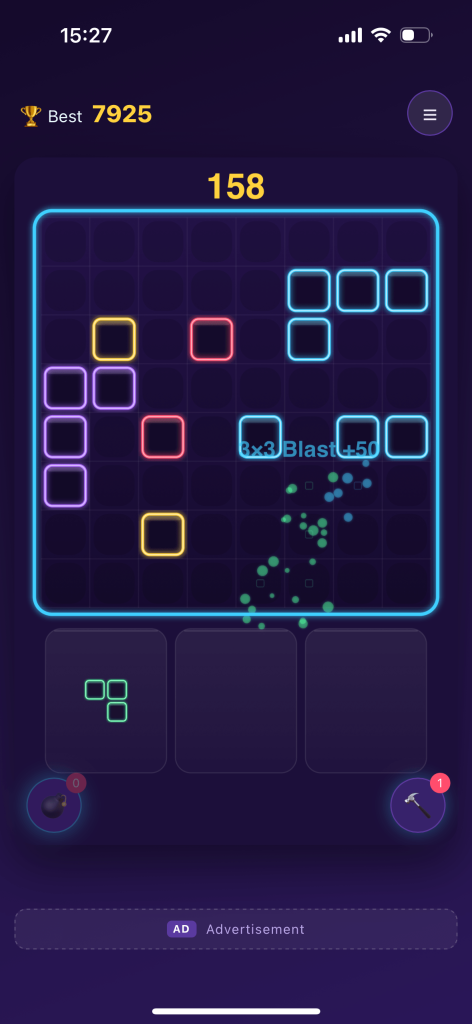
Let us be concrete rather than coy. Neon Block Blast is a free casual block puzzle from Shenzhen Jinjie Network Technology Co., Ltd., built on an 8×8 grid where you drag shaped blocks into place to complete rows and columns. There is no timer, blocks cannot be rotated, and the run ends when no available shape fits. It has an endless Classic mode and an Adventure mode with more than 40 handcrafted levels featuring ice, wood and stone obstacles, plus two power-ups earned by clearing lines: a Bomb that clears a 3×3 area and a Hammer that removes a single block.
Against the checklist: it is free to download and play, and it contains ads. Both modes are playable without paying. There is an optional one-time in-app purchase that removes ads permanently — a non-consumable upgrade, not a subscription. There are no consumable boosters for sale; the power-ups are earned through play. Progress is stored on the device with autosave, so there is no account or sign-in between you and the first move, and you can quit and resume the same board at any time. The game plays fully offline with no Wi-Fi needed, autosaves, has a small install footprint, and runs on Android 7.0 and above.
So, is it “really free”? Yes: you can play the whole game, both modes, for as long as you like, without paying anything. The trade-off is advertising. If you end up playing daily and would rather not see ads, the one-time upgrade is there. That is the entire monetisation story — no energy bar, no lives, no monthly charge, no pay-to-win.
If you want the feature-by-feature breakdown, see our Neon Block Blast review. For how the game’s design choices were made, including why there is no timer, read why we built a block puzzle with no timer. And if you want to get more out of each free session, our block puzzle tips and high-score strategies are a good next step — there is also a different take on the format in our guide to block puzzles and spatial reasoning.
What to Expect on Your First Install
The practical experience is short to describe. Install, open, and you are on the board — no account creation and no sign-in to work through. Start in Classic mode and play a few runs to get a feel for how quickly the grid fills; because there is no timer, you can take as long as you want over each placement. Move into Adventure when you want specific levels to work through. If you close the app mid-run, the board will be there when you return.
Decide about ads after you have played, not before. That is the whole point of a model like this: you get to see whether the game is worth keeping before being asked to pay for anything.
Play both modes free, then decide — download Neon Block Blast on Google Play: https://play.google.com/store/apps/details?id=com.jinjie.neonblast
Frequently Asked Questions
Are free puzzle games really free? Often yes, but the model varies. Some are supported by ads with full access to the game; others use energy systems, lives, or subscriptions that meter or gate play. Check the store description for the words “energy”, “lives”, “subscription”, and “in-app purchases” before installing.
What does “one-time purchase” mean in a free game? It means a single, non-consumable payment that permanently unlocks something — commonly ad removal. There is no renewal and nothing to cancel afterwards.
Does Neon Block Blast have a subscription? No. It is free to download and play with ads, and offers an optional one-time in-app purchase that removes ads permanently. There is no recurring charge.
Are the power-ups in Neon Block Blast paid? No. The Bomb and the Hammer are earned by clearing lines during play. They are not sold as consumables.
Do I need an account to play? No. Progress is saved on the device with autosave, so you can start playing immediately and pick up the same board later.
Can I play without Wi-Fi? Yes. The game is fully playable offline, which also makes it a practical choice for commuting and travel.
Is there an energy system or a limit on how many runs I can play? No. There is no timer, no lives, and no energy meter. A run ends only when no available shape fits on the grid, and you can start another immediately.
Where can I read the privacy policy? It is published on the developer’s site at https://www.ai-sp.cn/apps/neon-blast/privacy.html.
Also worth reading: the Adventure mode guide, block puzzle vs match-3 explained and the Neon Block Blast FAQ.
Further reading: games like Block Blast and how to choose an alternative and what defines a Block Blast-style 8×8 puzzle.
Views: 0