Every game is a stack of small decisions, and most of them are invisible when the game works. Players notice the visuals, the feel of a drag, the small burst when a line clears. They rarely notice the things that were deliberately left out — the countdown that was never added, the rotation button that was never drawn, the account screen that does not exist.
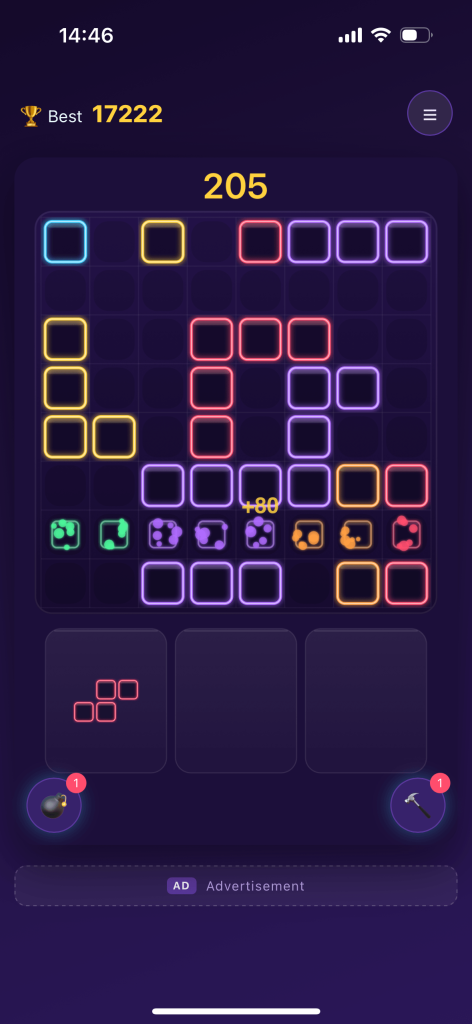
Those omissions are where Neon Block Blast was actually designed. We are Shenzhen Jinjie Network Technology Co., Ltd., and we built this game as a small, focused casual block puzzle: an 8×8 grid, a tray of shaped blocks, and one rule for removing anything — complete a full row or column and it clears. This is a note about why we made the choices we made, written for anyone curious about how a modest puzzle game gets put together. It is not a launch announcement or a feature roadmap; it is simply an explanation of the reasoning you can already see on the board.
We Started With a Feeling, Not a Feature List
The starting point was a fairly ordinary observation: the moments when people open a casual puzzle are usually the moments when they have a little time and not much attention to spare. Waiting for a train. The few minutes before a meeting starts. The quiet end of a day. Those gaps are short, unpredictable, and easily interrupted.
A lot of mobile games are designed for the opposite situation — long, uninterrupted sessions with a steady escalation of stakes. That is a completely valid design goal, but it does not describe the gap before a meeting. If you build for long sessions, you tend to add things that keep people in the game: streaks, countdowns, energy that refills, rewards that expire. Those mechanics work. They also assume the player has committed to being there.
We wanted the opposite: a game that is completely comfortable with you leaving at any second. That single requirement turned out to determine almost everything else. It is why there is no timer. It is why progress saves itself. It is why the game works offline. And it is why the monetisation is a one-time option rather than a recurring relationship.
Decision 1: No Timer
The easiest way to make a puzzle feel urgent is to add a clock. It is also the easiest way to make it feel like an obligation.
With a timer, the player’s task changes. Instead of asking “where is the best place for this shape?”, the question becomes “where can I put this shape before the countdown reaches zero?” Those are different games. One rewards evaluation; the other rewards speed. For a puzzle built around spatial planning, speed is mostly noise — it adds pressure without adding interesting decisions.
Removing the clock also changes what failure means. In a timed game, a loss is partly the clock’s fault. In Neon Block Blast, the run ends when no available shape fits, and that is entirely the consequence of earlier placements. That is a more honest kind of failure: you can look back three moves and see exactly where the board got fragmented. It makes improvement feel available rather than arbitrary.
There is a quieter benefit too. A game with no clock can be paused by life. You can put the phone down mid-thought, deal with whatever interrupted you, and come back to the same board. We wrote more about the player’s side of this in our guide to relaxing offline puzzle games without time limits; from the design side, the clock was simply the first thing that had to go.
Decision 2: Blocks Cannot Be Rotated
This is the decision people question most, because rotation is standard in grid puzzles and feels like a convenience. We left it out on purpose.
When a player can rotate a piece, most tight situations can be solved by adjusting the piece. That is satisfying in a small way, but it moves the challenge to the moment of placement. You can afford to be vague about the board, because you can fix things when you get there.
With rotation removed, the shapes in the tray become facts you cannot negotiate with. A vertical piece stays vertical. An L-shape keeps its exact orientation. Now the player has to read the board before placing: is there an empty region that matches this shape as it is? The skill shifts from correction to anticipation. You start keeping the middle open, placing the awkward shape first, and preserving empty space in forms that can accept a variety of fixed orientations.
That is a much more interesting game to us. It is also a calmer one: because you cannot fiddle your way out of a mistake, you are encouraged to slow down and think — which is exactly what a no-timer game invites. The two decisions support each other. If you want the practical version of this reasoning, our block puzzle tips and high-score strategies explains why the least flexible shape should usually be placed first.
Decision 3: Two Modes for Two Moods
A single elegant rule set can carry a game a long way, but people do not always want the same thing from it. So we built two modes rather than one mode with difficulty sliders.
Classic is the game in its purest form: an endless board, a steady supply of shapes, and your own score as the only opposition. There are no levels, no targets, and no ending other than a board that finally fills. It is the mode for a two-minute wait, and it asks nothing of you except to keep the space usable.
Adventure is structured. It has more than 40 handcrafted levels built around ice, wood, and stone obstacles that need to be smashed through. These obstacles do something useful beyond looking different: they partition the grid. A partitioned board is harder to keep flexible, so the player has to think about the order of clears, not just their number. The question changes from “how long can I survive?” to “what sequence opens this layout up?”
We like having both. They serve different moods without asking either type of player to accept a compromise. Someone who wants to zone out never has to think about a level target; someone who wants a finished puzzle to solve has more than 40 of them. And because the rules do not change between modes, anything you learn in Classic carries straight into Adventure.
Decision 4: Offline Play and Autosave Are Core Features
It is tempting to treat these as technical details — nice-to-haves you list near the bottom of a store description. For this game they are central to the whole idea.
Think about where the game gets played: underground, on a train, on a plane, in a building with a weak signal, on a device with a tight data plan. If the puzzle needs a connection, it fails precisely in the situations it was designed for. So Neon Block Blast is fully playable offline with no Wi-Fi needed. The core loop lives on the device; a network connection is not part of the experience.
Autosave follows from the same logic. If sessions are short and easily interrupted, closing the app must never cost the player anything. The board is saved automatically, so quitting mid-run is not a decision — you just close the phone and pick up the identical position later. There is no “are you sure you want to exit?” moment and no account to sign into before the first move. Progress is stored locally on the device.
Together, those two choices are what make “you can leave at any second” a real property of the game rather than a line of marketing copy. They also keep the first-run experience short: install, open, play.
Decision 5: A Small Install That Runs on Older Phones
A casual puzzle should not be a demanding app. There is no 3D scene to render, no large asset download, no streaming content — just a grid, some glowing shapes, and the logic that checks whether a line is complete. Keeping the install small and the requirements modest (Android 7.0 and above) means the game is available to people on budget devices, older handsets, and tablets that have been handed down.
We think that matters for this genre. A game people open in spare moments should not be the thing that fills their storage or drains their battery. Localising into English plus dozens of other languages follows the same reasoning: the rules are visual and need almost no text to explain, so there is no good reason to make the game unavailable to someone because of the language on their device.
Decision 6: Ads, With a One-Time Way Out
We wanted the game to be free to download and play, with both modes available to everyone. Advertising is what makes that possible. But the arrangement should be legible, and the player should be able to settle it once.
So Neon Block Blast contains ads, and there is an optional one-time in-app purchase that removes them permanently. It is a non-consumable upgrade, not a subscription. There is no energy meter, no lives that refill on a timer, and no consumable boosters for sale — the two power-ups in the game, a Bomb that clears a 3×3 area and a Hammer that removes a single block, are earned by clearing lines during play.
That last part is a design decision as much as a business one. If a power-up can be bought, the difficulty of the game eventually starts to be shaped around the option to buy it. We would rather the player’s escape from a jam come from something they earned by playing well. We go into the reasoning in more detail in our guide to free puzzle games without subscriptions. The short version: the free version should be complete, and the paid version should simply be quieter.
Decision 7: Neon Visuals That Stay Out of the Way
The look of the game had one job: make a cleared line feel good without demanding attention between clears.
Bright shapes on a dark board do that efficiently. A completed row disappearing in a burst of colour is immediate, readable feedback — you understand what happened without reading a number or watching an animation play out. The rest of the time, the interface stays quiet. There is no visual noise competing with the board, because the board is the whole game.
This is also why the effects are tied to player actions rather than running constantly. Feedback should reward a decision, not decorate the screen. A puzzle where every clear feels crisp encourages the deliberate, one-move-at-a-time rhythm the rules already ask for.
What We Chose Not to Chase
Designing a small game is mostly a matter of restraint. We did not want to manufacture reasons to return — no urgency mechanics, no pressure to protect a streak, no sense that a session was being scored by anyone other than the person holding the phone. None of that would have made the grid more interesting to solve.
We also did not want the game to be about spectacle. There is a lot you can add to a casual title — collections, narrative layers, competitive ladders, seasonal events. Some of those are excellent in the right game. Here they would have sat between the player and the one thing the game does well: a quiet board and a sequence of small decisions about space.
That is why the rules are so few. An 8×8 grid, shapes that cannot be rotated, complete a line to clear it, combos for clearing several at once, and a run that ends when nothing fits. Everything else in the app exists to support that loop or to get out of its way. There is a different angle on why those rules are mentally engaging in our article about block puzzles and spatial reasoning.
What We Are Watching Next
We are not going to announce features that are not shipped. What we can say is where our attention goes: keeping the game light and reliable on older devices, refining how the Adventure levels teach their obstacles, and listening for the points where players feel a run ended unfairly rather than through a decision they can learn from. The rules are stable; the craft is in the details around them.
If you want to see how all of this reads from the outside, our Neon Block Blast review walks through the modes, power-ups, offline play and the free-to-play model in full.
From the Studio
Neon Block Blast is developed and published by Shenzhen Jinjie Network Technology Co., Ltd. It is free to download and play, contains ads, and offers an optional one-time purchase that removes them permanently. It plays fully offline, autosaves your board, and runs on Android 7.0 and above. Our privacy policy is published at https://www.ai-sp.cn/apps/neon-blast/privacy.html.
We built it to be the thing you open for a few quiet minutes and close without a second thought. If that sounds like the puzzle you have been looking for, it is waiting on Google Play.
Download Neon Block Blast free: https://play.google.com/store/apps/details?id=com.jinjie.neonblast
Frequently Asked Questions
Why is there no timer in Neon Block Blast? Because a timer changes the task from choosing the best placement to placing something quickly. Removing it lets players evaluate the whole tray and stop whenever they need to.
Why can’t blocks be rotated? It shifts the challenge from adjusting pieces to reading the board. Fixed orientations make anticipation and space management the core skill, which suits a no-timer puzzle.
Why are there two modes? Classic serves short, open-ended sessions; Adventure offers 40+ handcrafted levels with ice, wood and stone obstacles for players who want a specific puzzle to solve. The rules stay the same across both.
Why does the game work offline? Because the moments when people want a short puzzle — commuting, flights, weak signal — are exactly the moments when a connection is least reliable. Offline play and autosave let a session be interrupted without losing anything.
Is there a subscription or an energy system? No. The game is free with ads, and the only purchase is an optional one-time, non-consumable upgrade that removes ads permanently. Power-ups are earned by clearing lines, not bought.
Who makes Neon Block Blast? It is developed and published by Shenzhen Jinjie Network Technology Co., Ltd. The official listing is on Google Play and the developer’s privacy policy is available at https://www.ai-sp.cn/apps/neon-blast/privacy.html.
Continue with the Adventure mode guide, block puzzle vs match-3 explained and the Neon Block Blast FAQ.
Further reading: games like Block Blast and how to choose an alternative and what defines a Block Blast-style 8×8 puzzle.
Views: 0